
US Residential Shipping in 2026: How USPS DDU and Carrier Mix Stop Rural Parcels Bleeding Margin

Updated: 3 days ago
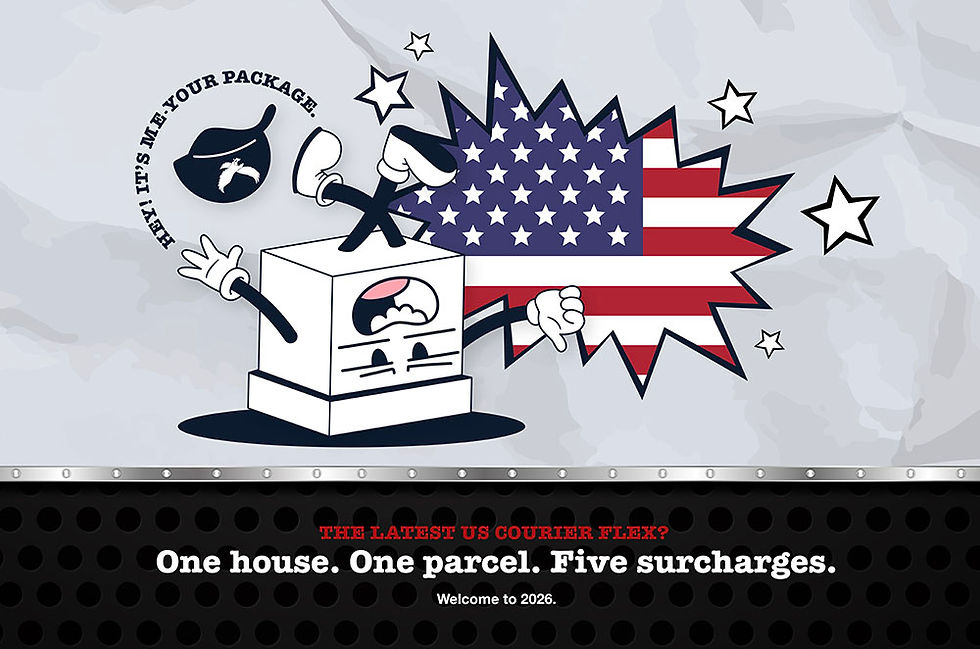
Hey! It's Me - Your Package... Let’s get specific, quickly.
This is a US-only problem, and it’s a nasty one.
If you ship ecommerce orders into or within the United States, especially to residential and rural ZIP codes, 2026 is the year shipping costs stop creeping and start compounding.
Not because base rates exploded.
Because residential delivery became the profit centre.
UPS and FedEx haven’t been shy about it either.
Over the past few years, they’ve quietly shifted margin recovery away from headline rate increases and into residential surcharges, delivery area fees, remote ZIP penalties, and fuel layered on top of all of it.
If you’re still routing every residential parcel the same way you did three years ago, you’re not “absorbing cost pressure”.
You’re subsidising it.
This blog is about the lever most shippers still underuse:
Selective USPS DDU injection, combined with an intentional carrier mix, used surgically to neutralise the ugliest US residential ZIPs.
Not everywhere.
Not blindly.
Exactly where it works.
What Is USPS DDU Injection for Ecommerce?
Let’s kill the jargon before it gets misquoted in a deck.
USPS DDU injection for ecommerce is a last-mile strategy where parcels are inducted into the United States Postal Service network at or near the local post office that serves the final delivery address, instead of paying a private carrier to run the entire route.
In practice, that means:
You move the parcel across the country yourself (or via a 3PL)
USPS handles the final mile
You avoid residential and delivery-area surcharge stacking
Why this matters in the US:
USPS delivers to every address, rural included
There is no separate residential surcharge
Delivery to extended and remote ZIPs is part of the mandate, not a penalty zone
DDU is not a carrier swap.
It’s a routing decision.
And when applied selectively, it’s one of the most effective ways to deflate residential cost inflation without torching customer experience.
The Real Residential Problem in the US (and Why It Keeps Getting Worse)
Private parcel networks are built on one thing: density.
Residential America has very little of it.
One parcel.
One driveway.
One stop.
No adjacent deliveries to share the cost.
According to ShipMatrix, the cost per stop in low-density residential routes can be two to three times higher than in dense urban delivery, before surcharges even enter the picture.
So carriers do what carriers do:
Keep base rate increases politically reasonable
Push yield into residential fees, DAS, and remote ZIP add-ons
Expand ZIP lists quietly, not loudly
The result?
Residential and area-based fees now account for 30–40% of total per-parcel cost variance between urban and rural US deliveries.
That’s not a rounding error. That’s the business model.
Why Negotiating Harder Doesn’t Fix Residential Shipping
This is where most shippers lose time.
They go back to their carrier and ask for:
Better discounts
A sharper pencil
A friendlier renewal
And sometimes, they get movement. On base rates.
But the real damage isn’t happening there.
BCG’s logistics cost studies show that savings driven by network design and carrier mix outperform pure rate negotiation by two to three times over a multi-year horizon.
Because you can’t negotiate away:
Rural geography
Delivery density
Fuel applying to accessorials
Residential classification rules
You can only route around them.
Carrier Mix: The Lever That Actually Moves the Needle
Carrier mix is not “adding another carrier”.
Carrier mix is deciding which carrier deserves which parcel.
The most resilient US ecommerce networks now look like this:
National carriers (UPS / FedEx)
Speed-critical orders
High-value shipments
Tight SLAs that genuinely drive conversion
USPS (Ground Advantage / DDU-style entry)
Light to mid-weight residential parcels
Rural and extended ZIPs
SLAs of 3–6 days, not overnight theatre
Regional carriers
Dense metro ZIPs
Short zones
Residential deliveries where they undercut nationals on both base and fees
MWPVL International benchmarks show that shippers using a diversified carrier portfolio see 10–20% lower residential cost per parcel compared with single-carrier strategies.
Not because one carrier is cheaper everywhere.
Because no carrier is cheapest everywhere.
UPS's Latest Flex: UPS 2026 Pricing - Why a “5.9% GRI” Is Really a 10-20% Cost Shock (And What Smart Shippers Are Doing About It)
How Much Can USPS DDU Save on Rural Residential Shipping?
This is the question that matters.
Not “is DDU interesting?” But “is it worth the operational friction?”
For US ecommerce brands with rural exposure, the answer is usually yes – selectively.
Here’s what the math looks like in the real world.
Typical rural residential cost comparison (US)
Parcel profile | Carrier path | Typical all-in cost (USD) | Typical savings |
2–5 lb, rural ZIP | UPS/FedEx end-to-end | $15–20+ (base + residential + DAS + fuel) | – |
2–5 lb, rural ZIP | USPS via DDU / destination entry | $10–13 | $2–5 per parcel |
1–3 lb, extended ZIP | UPS/FedEx Ground | $14–18 | – |
1–3 lb, extended ZIP | USPS Ground Advantage (deep entry) | $9–12 | ~$3–4 per parcel |
What’s doing the work here isn’t a miracle discount.
It’s the absence of surcharge stacking.
Pitney Bowes reports multi-carrier shippers, including USPS, achieving around 16% average per-parcel savings, or roughly USD 2.25 per shipment, by routing residential volume away from a single-carrier model.
Multiply that by 50,000 rural orders a year and DDU stops being “nice to have”.
Where USPS DDU Actually Makes Sense (and Where It Doesn’t)
DDU is not a universal fix. It’s a scalpel.
Strong DDU candidates
US residential ZIPs flagged as DAS, extended, or remote
Parcels between 1–10 lb
Non-hazmat, non-oversize
SLAs where 3–6 days is acceptable
Orders where margin matters more than speed theatre
Poor DDU candidates
Guaranteed overnight delivery
Time-critical medical or perishables
Oversize or awkward freight
Customers explicitly promised “fast or free”
This is why DDU works best inside a multi-carrier framework, not as a replacement strategy.
2026 Reality Check: DDU Access Is Changing
This is the part most blogs ignore.
From 2026, USPS is moving DDU access toward a formal, bid-driven model.
What that means in practice:
18,000+ DDUs opened under structured access
Shippers (or their 3PLs) propose volume, pricing, and tender windows
Access is awarded based on network fit, not enthusiasm
Industry briefings point to late Q3 2026 as the practical start window
Translation: DDU is still viable. But it’s no longer casual.
For most ecommerce brands, the realistic path is:
Working through a 3PL or consolidator like Transport Works with existing DDU programs and committed volume
Participating via aggregated bids rather than going solo
That makes modelling, data discipline, and volume planning more important than ever.
How This Actually Runs Operationally
No magic. Just flow.
Fulfilment centre→ consolidation hub (yours or a 3PL’s)→ linehaul into destination region→ USPS DDU or SCF→ USPS carrier route to the doorstep
Once parcels hit the DDU, USPS delivery is typically next day.
Your SLA is controlled by:
How fast you consolidate
How efficiently you linehaul
How selectively you route
Volume density lowers linehaul cost. Density is what turns DDU from theory into savings.
The Tech Layer That Makes This Survivable
This strategy collapses without automation.
Winning shippers use multi-carrier routing platforms that:
Rate by landed cost, not base rate
Route by ZIP, weight, dimensions, and promise date
Refresh logic monthly as carrier fees change
Deloitte estimates dynamic routing and carrier optimisation can reduce last-mile delivery costs by 15–30%, depending on residential mix.
That’s not AI hype. That’s letting the maths do the work humans shouldn’t.
The Quiet Truth Most Brands Miss
Residential delivery doesn’t need to be “fixed”.
It needs to be contained.
Use premium carriers where speed earns its keep. Use USPS where geography punishes density.
Use regionals where they naturally win.
Do that, and residential shipping stops being a tax on growth and starts behaving like a controlled cost.
Want to make residential shipping less margin-munching monster and more controlled network? Read:
THE BRAINS BEHIND BETTER DECISIONS.
LOCAL CHAOS. GLOBAL CONTROL.
USPS DDU & US Residential Shipping FAQs
What is USPS DDU injection for ecommerce shipping?
USPS DDU injection is a last-mile strategy where ecommerce parcels are inducted into the United States Postal Service network at or near the local post office that serves the delivery address, allowing USPS to complete final delivery instead of a private carrier.
For US ecommerce brands, this matters because USPS does not apply separate residential or delivery area surcharges, and it delivers to every address, including rural and extended ZIP codes. When used selectively, DDU injection reduces exposure to stacked residential fees from national carriers.
Why are US residential shipping costs increasing so fast in 2026?
US residential shipping costs are rising quickly in 2026 because carriers like UPS and FedEx are recovering margin through residential surcharges, delivery area fees, remote ZIP penalties, and fuel applied on top of those fees.
Rather than raising base rates aggressively, carriers have expanded surcharge coverage and increased fee amounts, particularly for rural and low-density residential routes where delivery cost per stop is significantly higher than in urban areas.
How much can USPS DDU save on rural residential parcels?
Selective USPS DDU injection can typically save USD 2–5 per parcel on rural or extended-area residential shipments compared to end-to-end UPS or FedEx Ground delivery.
These savings come primarily from avoiding residential and delivery area surcharge stacking, not from lower base rates. Actual savings depend on parcel weight, ZIP code, delivery promise, and the shipper’s linehaul and consolidation efficiency into the destination region.
Is USPS DDU still viable in 2026 with the new access rules?
Yes, USPS DDU remains viable in 2026, but access is shifting to a more structured, bid-based model.
USPS is opening access to more than 18,000 Destination Delivery Units under formal bid solicitation, where shippers or their partners propose volume, pricing, and tender windows. For most ecommerce brands, the practical approach is working through a 3PL or consolidator like Transport Works with existing DDU programs rather than attempting direct, standalone access.
Should all US residential parcels be routed through USPS DDU?
No. USPS DDU should be used selectively, not universally.
DDU works best for lightweight, non-urgent residential parcels going to rural or extended ZIP codes with delivery expectations of three to six days. Speed-critical, high-value, oversized, or time-definite orders are often better served by national or regional carriers within a broader multi-carrier strategy.
Final Word
If your US residential strategy is still: “Same carrier, better discount”
You’re already behind.
The brands that survive 2026 won’t ship cheaper.
They’ll ship selectively.
And that’s exactly where DDU and carrier mix turn from tactics into leverage.
Transport Works. Always delivering. Especially where the margin leaks are hiding.
Insights from Danyul Gleeson, Founder & Logistics Chaos Tamer-in-Chief at Transport Works
Danyul has been in the trenches - warehouses where pick paths were sketched on pizza boxes and boardrooms where the “supply chain strategy” was a shrug. He built Transport Works to flip that script: a 4PL that turns broken systems into competitive advantage. His mission? Always Delivering - without the chaos.
Disclaimer:
The information in this blog is provided for general informational purposes only and is current as of the date of publication. Customs duties, charges, processes, policies, and rates are subject to change at any time without notice. We make no representations or warranties of any kind, express or implied, about the completeness, accuracy, reliability, suitability, or availability of the information contained in this article. You should not rely on this content as a substitute for official sources. For the most up-to-date and authoritative information, please consult the relevant government agencies, customs authorities, and reference websites directly. Ideas, interpretations, and opinions expressed here are subject to change as regulations, markets, and industry practices evolve. Transport Works and its authors accept no liability for any loss or damage whatsoever arising from reliance on the information in this blog.
Sources & References
Core Carrier & Postal Sources (Authoritative)
United States Postal Service USPS Ground Advantage Product Guide Parcel Select Destination Entry & Workshare Documentation Delivering for America – Network & Cost Optimisation Updates
UPS UPS Rate & Service Guides (2024–2026) UPS Residential, Delivery Area & Remote Surcharge Tables
FedEx FedEx Rate, Surcharge & Delivery Area Documentation FedEx Ground Residential Pricing Guides
Independent Parcel Economics & Benchmarking
ShipMatrix Parcel Shipping Intelligence ReportsCarrier Cost & Performance Analysis (Residential vs Commercial)Used for:
Cost per stop variance
Residential vs rural delivery economics
Surcharge impact analysis
MWPVL International Parcel Logistics Benchmark ReportsMulti-Carrier Strategy & Cost Reduction Studies Used for:
Carrier mix effectiveness
Residential cost reduction benchmarks (10–20%)
Pitney Bowes Pitney Bowes Parcel Shipping Index Used for:
Multi-carrier savings benchmarks
Per-parcel cost reduction examples (≈16%, ≈USD 2.25)
Consulting & Industry Research
Deloitte Last-Mile Delivery & Logistics Optimisation Reports Used for:
Cost per stop comparisons
Dynamic routing savings (15–30%)
Boston Consulting Group Global Logistics Cost Management & Network Design Insights Used for:
Network design vs negotiation savings (2–3x impact)


Comments