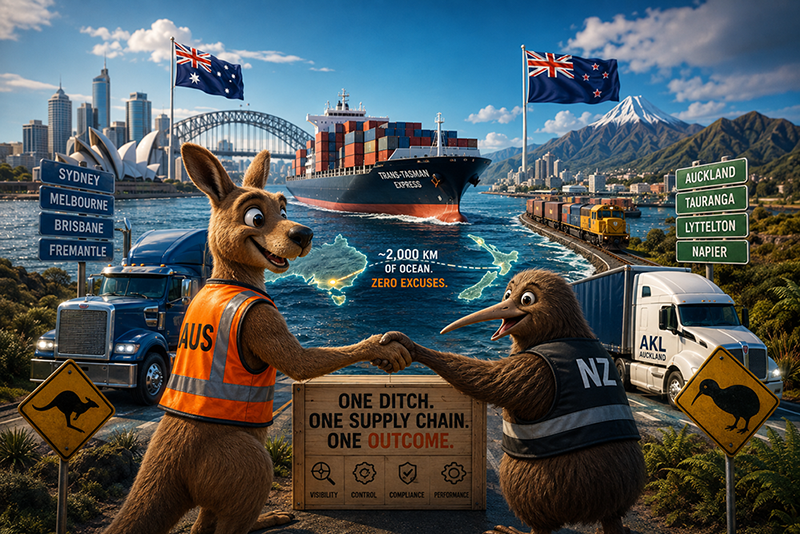
Trans-Tasman Shipping Modes, Lanes & Transit Times: The Operator’s Guide
Five days across the Tasman... Seven days of consequences.
On paper, Trans-Tasman freight is almost offensively simple.
Australia there. New Zealand there. Bit of water in between. Plenty of ships. Plenty of planes. Plenty of people prepared to send you a rate card with 5–7 DAYS sitting confidently in a little box.
Lovely.
Then somebody plans stock against the little box.
Sales promises against the little box.
Finance trims inventory because the little box has been behaving itself lately.
Production misses cut-off by four hours.
And your five-day freight journey suddenly takes twelve.
Welcome to Trans-Tasman shipping transit times, where the ocean is usually the easy bit.
The expensive part is everything the business assumes will happen around it.
That is why this is not really a guide to which vessel reaches Auckland fastest.
Anyone with a carrier schedule can tell you that.
The useful question is what happens when a supposedly simple freight lane starts quietly deciding how much stock you hold, how often you airfreight, whether the warehouse has enough product for Friday, and why Customer Service has started using words ordinarily reserved for divorces.
Because the Tasman is short.
The chain reaction behind it is not.

Trans-Tasman shipping transit times 2026: the numbers everybody wants first
Let us get the timetable out of the way before somebody from Procurement develops a rash.
Indicative 2026 transit ranges:
Lane / Mode | Indicative transit | The bit the schedule forgets to mention |
Sydney → Auckland FCL | ~5 days on OOCL ANS | Miss a weekly cut-off and congratulations, you just found another seven |
Melbourne → Auckland FCL | Service-dependent | Fine until stock cover is also running on fumes |
Sydney → Auckland LCL | ~5–14 days currently advertised | Consolidation, handling and somebody else’s cargo joining the adventure |
Sydney → Lyttelton | Service-dependent | Slower at sea can still be faster to Christchurch |
Brisbane → Auckland | Service-dependent | Useful Queensland connection, but check the live rotation |
Standard / economy air | Typically 2–5 business days | Expensive, but still cheaper than some stockouts |
Express air | Typically next business day on FedEx Trans-Tasman | The official transport mode of “how did nobody see this coming?” |
Sources: OOCL ANS Weekly Trans-Tasman Service; ANL TRANZTAS Service; Flexport Sydney - Auckland live LCL rates; FedEx Trans-Tasman Service. Transit times are indicative and vary by carrier, service, sailing, cut-off, capacity and cargo profile. Always verify the live schedule before booking.
And now the part that matters.
A transit time is not a supply-chain outcome.
It is one number inside one leg inside one plan that probably involves production finishing when promised, documentation arriving without interpretive dance, equipment being available, the container making cut-off, the vessel holding schedule, customs behaving and the destination warehouse still having enough stock left to care.
This is why Sydney to Auckland shipping time can technically be five days and commercially be two weeks.
The vessel is counting port to port.
Your business is counting panic to replenishment.
Different clock.
Sea vs air freight: sometimes the aircraft is just carrying your earlier mistake
Airfreight gets a terrible reputation.
Too expensive.
Too reactive.
Too painful.
Which is true.
But airfreight is often not the problem.
It is the receipt.
A stockout started three weeks earlier.
A production delay started five days earlier.
A forecast went soft around the edges sometime last month.
Nobody did anything because the vessel still technically existed.
Then Thursday arrives wearing steel-capped boots and suddenly 700 kilograms has to be in Auckland by Monday.
Cue the aircraft.
The lazy comparison is freight cost.
Sea costs this.
Air costs that.
Therefore sea is cheaper.
Gold star. Everyone go home.
Except freight is only cheaper if the time you saved money on is commercially worthless.
For a normal replenishment shipment with healthy stock cover, sea wins easily.
For a launch sitting three days from failure, the maths changes rather quickly.
If the shipment is… | The obvious mode is usually… | Until… |
Heavy, predictable replenishment | Sea | Inventory gets too thin |
Small and genuinely time-sensitive | Air | The urgency is artificial |
Sitting between obvious sea and obvious air economics | Quote both | One delay costs more than the freight difference |
Replacing a stockout | Air | Someone fixes why the stockout keeps happening |
Routine cargo sent urgently every month | Neither answer is the real answer | Your planning process is on fire |
There is a grey zone where neither sea nor air wins automatically. Shipment weight matters, but so do value density, inventory cover, available sailings, air capacity, fuel surcharges and the commercial cost of another day in transit. In that zone, quote both. The answer is not stable enough to deserve a rule of thumb.
The grey zone is not a weight band. It is the point where the cost of transport and the cost of waiting start arguing with each other.
Because the decision is no longer “sea or air?”
It is:
How much does another day now cost us?
That might be nothing.
It might be a retailer penalty.
It might be a production line.
It might be three days of WISMO, lost sales and a customer quietly trying your competitor.
Transport has a price.
Time has a price too.
Only one of them usually arrives as a freight invoice.
FCL vs LCL: welcome to the container share-house
LCL sounds lovely in theory.
Only pay for the space you use.
Efficient.
Flexible.
Economical.
Very civilised.
Then you remember you are sharing a container with strangers.
Suddenly your immaculate shipment is living in a freight share-house where one flatmate has questionable timber packaging and another appears to have declared something using optimism rather than facts.
The old FCL vs LCL Trans-Tasman rule of thumb used to put the crossover somewhere around 10 CBM.
As a practical rule of thumb, FCL and LCL economics often start colliding around 13–15 CBM. On Sydney - Auckland, that is the point where we would stop trusting the old “LCL is cheaper because it’s smaller” logic and price both against the live lane.
Volume | Likely answer |
5 CBM | LCL usually wins |
10 CBM | Still usually LCL |
13–15 CBM | Quote both and stop trusting folklore |
18 CBM | FCL is increasingly likely to make sense |
25 CBM+ | FCL will often win clearly |
Why the wobble room? Because LCL cost rises with chargeable volume and handling, while FCL is largely a flat container cost. The crossover moves whenever the lane rate, CFS charges, destination fees, cargo density or container pricing moves. Current industry guidance commonly places that crossover around 13–15 CBM, but the live quote gets the final vote
But cubic metres are only half the story.
The other half is control.
LCL carries consolidation time. More touches. More hands. More waiting. More opportunities for your shipment to become collateral damage in somebody else’s compliance problem.
The source guide specifically flags the risk of a shared LCL container being held when another consignment triggers MPI inspection.
Which produces a far more useful question than “when is FCL cheaper?”
When does not sharing the container become worth paying for?
If you have six weeks of stock, perhaps never.
If the cargo feeds a line that stops Tuesday morning, the answer may arrive several cubic metres before the spreadsheet says it should.
This is what freight comparisons regularly miss.
They calculate the cost of the box beautifully.
The business consequences are scribbled in invisible ink.
The fastest port can give you the slowest freight
Auckland has somehow become New Zealand in a surprising number of freight plans.
Christchurch would like a word.
So would Tauranga.
Possibly Nelson.
Definitely anyone who has ever paid to land freight in one part of the country and then drag it halfway across another because that was how the lane had “always been set up.”
Lane | Current indicative transit | Makes sense when… |
Sydney → Auckland | ~5–10 days | Freight belongs in northern NZ |
Sydney → Tauranga | ~7 days | BOP / Waikato network works better |
Sydney → Lyttelton | ~13–17 days | Cargo actually belongs in the South Island |
Melbourne → Auckland | ~7–11 days | Northern NZ distribution |
Melbourne → Lyttelton | ~10–14 days | Avoiding Auckland + domestic NZ freight matters |
Auckland → Sydney | ~4–14 days depending rotation | Core NZ export flow |
Tauranga → Melbourne | ~6 days | BOP origin + VIC destination line up |
The 2026 Trans-Tasman lane map makes the problem obvious. There is no single “Australia to New Zealand transit time.” The same port pair can move several days depending on the carrier and rotation you actually book.
Sources: OOCL ANS Weekly Trans-Tasman Service and 2026 schedule updates; ANL TRANZTAS live schedules and July/August 2026 service enhancement. Transit times are indicative port-to-port planning ranges derived from published carrier schedules and can change by vessel, rotation, omission and schedule recovery. Always verify the live sailing before booking.
A direct Sydney–Lyttelton sailing can spend longer on the water than Sydney–Auckland and still create a better supply-chain outcome for Christchurch freight.
Because the boat is not the supply chain.
Shocking news, apparently.
Origin cartage matters.
Cut-off matters.
Sailing frequency matters.
Port dwell matters.
Domestic freight matters.
Double handling matters.
The warehouse at the other end definitely matters.
Optimising only the ocean leg is how businesses save two days at sea and lose three on land.
The vessel looks fantastic on the KPI report though.
Frame it.
The weekly sailing: where four hours becomes seven days
There are few pieces of freight mathematics more insulting than missing a weekly sailing.
Cargo ready Tuesday?
Excellent.
Cargo ready Wednesday afternoon?
See you next week.
A business can spend six months arguing over whether a carrier can shave twelve hours from transit and then casually tolerate a seven-day miss because production and shipping cut-offs have never actually met each other.
This is why sailing frequency can matter more than sailing speed.
If Service A takes five days but your operation misses it one week in four, and Service B takes seven days but reliably matches production, which service is actually faster?
The answer is not sitting in the carrier brochure.
It is hiding in your shipment history.
This is classic Transport Works territory because it looks like a freight problem and smells like one too.
But the failure is often upstream.
Production planning does not know the cut-off.
The freight team finds out the cargo is late after the booking is made.
Warehouse receives a collection request that would require time travel.
Then Transport gets asked why delivery is seven days late.
Because apparently logistics also runs the calendar.
2026 carrier rotations: your lane changed while your routing guide was asleep
Trans-Tasman services are not carved into stone.
They are written in dry-erase marker.
ANL revised its TransTas rotation in August 2026, adding a second Auckland call. MSC launched its Southern Loop in May 2026, creating broad coverage through Bluff, Port Chalmers, Lyttelton, Wellington, Nelson and Napier. Maersk has also reshaped how some Trans-Tasman coverage operates through its wider Oceania network.
For operators, these are not shipping-news footnotes.
They can change the network.
A second Auckland call creates another possible recovery window.
A direct South Island service can remove domestic transport.
A changed rotation can turn yesterday’s clever port pair into today’s scenic route.
And yet some businesses will still be shipping the same way in 2028 because Darren set the lane up in 2021 and Darren has since left the company, taking all known reasoning with him.
This is how freight networks age.
Not with a bang.
With a routing guide nobody questions.
The trucks still arrive.
The invoices still reconcile.
Nobody declares an emergency.
You simply bleed a little more money every month than you needed to.
Very polite. Very expensive.
ETA: the E is doing a heroic amount of work
Estimated Time of Arrival.
The clue has been sitting there the whole time.
Estimated.
Not promised.
Not sworn before witnesses.
Not “Finance may now safely remove seven days of inventory.”
Estimated.
Yet an ETA enters a business and immediately starts reproducing.
It becomes a warehouse labour plan.
Then a customer commitment.
Then a sales forecast.
Then a replenishment assumption.
Then somebody copies it into PowerPoint and suddenly the board believes it too.
Meanwhile the vessel has encountered weather, port congestion, an upstream delay or a berth window that has developed other plans.
The problem is not that ETAs move.
ETAs will move.
The problem is what happens next.
A supply chain with decent visibility sees the movement early and changes something.
A supply chain with tracking sees a red dot twelve hours later.
A supply chain with neither discovers it when somebody asks why the shelf is empty.
Those are three very different levels of control.
And no, buying another dashboard does not automatically move you from one to the other.
Sometimes it just gives the chaos better lighting.
Peak season: China can ruin your Trans-Tasman shipment without ever touching it
This is where supply chains stop respecting departmental boundaries.
Chinese New Year cargo does not need to be inside your Trans-Tasman container to affect your Trans-Tasman container.
Carriers reposition vessels.
Equipment tightens.
Import volumes hit yards.
Blank sailings appear.
Containers pile up in places everybody confidently assumed they would not.
The attached planning brief identifies the post-Chinese-New-Year ripple as potentially stretching well beyond the holiday itself, with extra booking time and transit buffer required through the peak window.
Then cyclone season wanders in.
A ship does not need to be carried onto Queen Street by a cyclone for weather to matter.
A twelve-hour slip can lose a berth.
The lost berth creates a queue.
The queue moves another vessel.
That vessel misses another window.
By Friday, something that began as “a bit rough offshore” has become an inventory meeting.
This is what makes logistics systems entertaining in the same way loose electrical wiring is entertaining.
Everything is connected.
Usually behind the wall.
We removed the stock. Then blamed the freight.
This may be the most important part of the whole Trans-Tasman conversation.
Businesses have spent years getting leaner.
Less safety stock.
Less working capital.
Tighter replenishment.
Shorter customer lead times.
More SKUs.
More precision.
More confidence.
Fantastic.
Except every day removed from inventory cover increases the amount of perfection required from transport.
If the warehouse once carried 30 days of stock, a two-day vessel delay was irritating.
At eight days of cover, it is a meeting.
At three days, it has an airfreight quote attached.
This is where companies start blaming freight for becoming expensive.
But freight did not make the network fragile.
The business simply removed the shock absorbers and kept driving at the same speed.
You see it in premium freight constantly.
Someone sees A$12,000 of emergency airfreight and asks why Logistics spent so much.
Fair question.
Better question:
What happened upstream that made spending A$12,000 the least bad option left?
Late production?
Forecast miss?
Supplier delay?
Inventory cut too close?
Customer promise made in a completely different meeting?
Repeated premium freight is not a freight strategy.
It is a smoke alarm.
Stop changing the batteries and look for the fire.
Same shipment. Five freight options. One thing actually matters.
A Sydney cosmetics brand needs to move 14 CBM and 1,800kg of stock worth A$85,000 into Auckland by the end of Week 3.
The indicative model produces five choices:
Option | Indicative cost | Approx. transit |
Standard LCL | A$3,059 | 12 days |
Premium groupage | A$3,209 | 9 days |
20' FCL | A$4,869 | 7 days |
Standard air | A$6,689 | 3 days |
Express air | ~A$8,000 | 1–2 days |
These are worked-example assumptions rather than live market quotations.
A rate comparison says LCL wins.
A transit comparison says express wins.
Neither answer is especially intelligent.
The useful question is:
What happens to the business if this cargo arrives on Day 12 instead of Day 9?
Nothing?
Use standard LCL.
Retail launch at risk?
Keep going.
Production line stops?
Keep going.
Customer worth A$400,000 starts buying elsewhere?
Now the freight difference looks like lunch money.
That is what gets lost when businesses optimise transport without attaching transport to consequence.
The “best” mode does not exist There is only the option whose cost makes sense relative to what it protects.
Frequently asked questions about Trans-Tasman shipping
How long does shipping take from Australia to New Zealand?
Trans-Tasman sea freight typically takes around 5–13 days port-to-port depending on the Australian origin, New Zealand destination, carrier rotation and service, while air freight typically takes around 1–4 business days.
Sydney to Auckland FCL can be around 5–7 days, Melbourne to Auckland around 7–9 days, while direct South Island services may take longer. LCL generally needs additional time for consolidation and deconsolidation.
The bit worth remembering is that port-to-port transit is not the same as stock-ready-to-stock-available. A five-day sailing can still produce a twelve-day replenishment problem if cargo misses cut-off, waits in consolidation or loses time at either end.
How long does shipping take from Sydney to Auckland?
Sydney to Auckland FCL sea freight typically takes around 5–7 days port-to-port, while LCL can take around 10–12 days once consolidation is included.
Standard air freight can reduce that to roughly 2–4 business days, with express services potentially operating within 1–2 days depending on the carrier and service.
But “Sydney to Auckland shipping time” becomes a fairly useless number if Tuesday’s cargo misses Tuesday’s sailing.
Miss a weekly cut-off by four hours and your five-day transit has just discovered another seven.
That is why experienced operators plan against cargo-ready to inventory-available, not whichever number looks nicest on the carrier schedule.
How long does shipping take from Melbourne to Auckland?
Melbourne to Auckland FCL sea freight typically takes around 7–9 days port-to-port, depending on the carrier rotation and sailing schedule.
That is perfectly comfortable if the Auckland warehouse has twenty days of stock.
It becomes considerably more exciting when it has nine.
The transit time has not changed.
The business has removed its ability to tolerate it.
This is why Transport Works treats inventory cover and freight transit as part of the same decision, rather than two different spreadsheets pretending not to know each other.
Is sea freight or air freight better between Australia and New Zealand?
Sea freight is usually the better option for predictable, heavier Trans-Tasman replenishment, while air freight makes sense when the commercial cost of waiting is greater than the additional transport cost.
For shipments in the rough 200–1,000kg grey zone, both options should often be priced and considered against stock cover, urgency, shipment value and the consequence of delay.
The lazy decision compares freight rates.
The useful decision asks:
How much does another day cost the business?
If the answer is nothing, use the boat.
If the answer is a production shutdown, missed launch or customer heading toward a competitor, keep calculating.
When should I use air freight instead of sea freight from Australia to New Zealand?
Use Trans-Tasman air freight when the value of recovering several days is greater than the premium you pay for the faster service.
Typical triggers include stockouts, urgent replenishment, launch inventory, high-value goods and customer or production commitments that cannot absorb a sea-freight delay.
But repeated emergency airfreight deserves a harder question.
If routine cargo keeps becoming urgent, airfreight is probably not the problem.
It is the smoke alarm.
Late production, poor forecasting, insufficient inventory or a commercial promise made somewhere upstream usually supplied the fire.
What is the FCL vs LCL break-even point for Trans-Tasman freight?
For Sydney to Auckland general cargo, the practical 2026 FCL vs LCL crossover in the article’s model sits around 13–15 CBM, although live freight rates and origin/destination charges can move that point.
Below that range, LCL will often remain cheaper.
Above it, FCL increasingly becomes commercially attractive.
But cubic metres are only half the decision.
FCL also buys something harder to put in the rate column:
control.
LCL means more handling, consolidation and dependency on other consignments inside the same container. Sometimes the extra cost of FCL is buying space.
Sometimes it is buying distance from Gary and his suspicious timber packaging.
Is LCL or FCL faster between Australia and New Zealand?
FCL is generally faster and more predictable than LCL because it avoids the additional consolidation and deconsolidation processes required for shared-container freight.
On Sydney to Auckland, the article uses roughly 5–7 days for FCL versus around 11 days for LCL as an indicative comparison.
But the real advantage can be control rather than raw speed.
With LCL, your compliant cargo can still lose time because another consignment in the same container develops a customs or biosecurity problem.
Your freight did nothing wrong.
It simply chose unfortunate housemates.
What is the best port for shipping freight from Australia to New Zealand?
The best New Zealand port is the one that produces the strongest end-to-end supply-chain outcome, not necessarily the shortest ocean transit.
Auckland makes sense for much of northern New Zealand.
Tauranga can make more sense for the Bay of Plenty and Waikato.
Lyttelton can make more sense for Christchurch and South Island distribution.
Shipping Christchurch freight through Auckland simply because Auckland has the shorter sea transit can create extra domestic freight, another handover and more time on land.
The fastest vessel can still give you the slowest freight.
Optimise the network.
Not the patch of ocean in the middle.
Is it better to ship directly to Lyttelton instead of Auckland for South Island freight?
Direct shipping to Lyttelton can be the better option for South Island freight even when the ocean transit is longer than shipping to Auckland.
Sydney to Lyttelton may take around 10–12 days compared with roughly 5–7 days to Auckland, but the direct service can remove an Auckland discharge, additional handling and a domestic New Zealand movement.
That is the trap in port-to-port optimisation.
Save two days at sea.
Lose three on land.
Then congratulate the vessel.
Why does missing a Trans-Tasman sailing add so much time?
Most Trans-Tasman ocean services operate on scheduled rotations, so missing a weekly cut-off can add close to another week before the next suitable sailing.
That means cargo finishing four hours after cut-off is not really four hours late.
It may now be seven days late.
This is why sailing frequency, cargo-ready dates and production alignment can matter more than shaving another half-day from the published transit.
If your operation repeatedly misses the “fastest” service, it is not your fastest service.
It is just a very attractive timetable you rarely use.
How reliable are Trans-Tasman shipping ETAs?
Trans-Tasman ETAs should be treated as operating estimates rather than fixed delivery commitments because vessel schedules can move with weather, port congestion, berth availability and upstream delays.
The problem is not that ETAs change.
They will.
The problem is what happens inside the business when they do.
A company with real visibility sees a three-day movement early enough to change inventory allocation, routing or customer commitments.
A company with tracking watches the dot move.
A company with neither discovers the problem when somebody asks why the shelf is empty.
Same vessel.
Very different supply chain.
How far in advance should I book Trans-Tasman sea freight?
Trans-Tasman sea freight should generally be booked early enough that missing the preferred sailing still leaves the business with another workable option.
The exact booking window varies by carrier, lane, equipment and seasonal demand, so there is no magic number that survives every week of the year.
That is the important distinction.
A shipment is not well planned because somebody booked it three weeks ahead.
It is well planned because the operation still has choices if Plan A falls over.
Once the entire supply chain depends on one vessel, the booking may be confirmed.
The risk certainly is.
How does peak season affect Trans-Tasman freight?
Peak periods can affect Trans-Tasman freight through tighter capacity, vessel repositioning, equipment pressure, port congestion and schedule disruption even when the original disruption occurs outside the Australia - New Zealand lane.
Chinese New Year is the obvious example.
Your container does not need to visit China for wider Oceania capacity to become uncomfortable.
Carrier networks do not respect the neat budget categories companies use internally.
China freight.
Trans-Tasman freight.
Domestic freight.
Lovely folders.
Same network.
One wobble upstream can still arrive several decisions later disguised as an Auckland stockout.
Why does Trans-Tasman freight become expensive when the lane is so short?
Trans-Tasman freight often becomes expensive because businesses treat the short distance as permission to remove inventory, time and routing buffers.
The Tasman itself is not particularly difficult.
Confidence is.
A thirty-day international movement gets contingency planning.
A five-day movement gets “she’ll be right.”
Then inventory gets thinner, customer commitments get tighter and one missed sailing suddenly has access to revenue.
Short lanes do not eliminate supply-chain risk.
They make it easier to pretend you do not need protection from it.
What is the cheapest way to ship freight from Australia to New Zealand?
The cheapest Trans-Tasman freight option depends on shipment volume, weight, urgency, lane and the commercial cost of additional transit time, so the lowest freight rate is not always the lowest-cost supply-chain decision.
For smaller non-urgent shipments, LCL will often win.
At larger volumes, FCL becomes increasingly competitive.
For truly urgent cargo, air can be commercially cheaper despite a much larger freight invoice if it prevents a stockout, production stoppage or lost customer.
Cheap freight is easy to identify.
Cheap consequences are considerably harder.
What is the biggest mistake businesses make when planning Trans-Tasman freight?
The biggest mistake is treating a published transit time as though it were an end-to-end supply-chain guarantee.
A five-day ocean journey gets turned into a replenishment assumption.
The replenishment assumption becomes an inventory policy.
The inventory policy becomes a customer promise.
Then the vessel moves two days and half the company behaves as though maritime transport has breached a personal agreement.
The Tasman is not particularly wide.
The gap between “5–7 days” and everything the business expects those five days to protect can be enormous.
The most expensive freight decision is usually the one made after all the cheap decisions died
This is the pattern.
Four weeks out, you have choices.
Different carrier.
Different sailing.
Different port.
Different mode.
Split shipment.
Inventory transfer.
Plenty of room to be clever.
Then time disappears.
At two weeks, some options die.
At one week, more go.
At 48 hours, everyone discovers how beautifully simple airfreight is.
This is why the strongest Trans-Tasman operators are not obsessed with finding the fastest service.
They are obsessed with not running out of options.
They know when LCL is genuinely economical and when it is simply cheaper on the quote.
They know when FCL is buying container space and when it is buying control.
They know when Auckland is the correct port and when Auckland is just the answer nobody has challenged since Darren left.
They know a five-day transit with a missed weekly cut-off is, in fact, a twelve-day transit wearing a nice shirt.
And they know the shortest route across the Tasman is not always the shortest route through the supply chain.
Because Australia and New Zealand are close.
That has never stopped logistics finding somewhere to hide the problem.
Transport Works. Because Your Supply Chain Won’t Fix Itself.
Want to know what else can happen between “booked” and “bloody hell, where is it”? Read:
The Brains Behind Tasman Freight
Local Chaos. Trans-Tasman Control.
INSIGHTS FROM DANYUL GLEESON, FOUNDER, CLUSTER-FREIGHT-FIXER & LOGISTICS CHAOS TAMER-IN-CHIEF AT TRANSPORT WORKS
Danyul has been in the trenches - warehouses where pick paths were sketched on pizza boxes and boardrooms where the “supply chain strategy” was a shrug. He built Transport Works to flip that script: a 4PL that turns broken systems into competitive advantage. His mission? Always Delivering - without the chaos.
Sources & References
Trans-Tasman trade and ANZCERTA
Australian Government Department of Foreign Affairs and Trade (DFAT) – Australia-New Zealand Closer Economic Relations Trade Agreement (ANZCERTA)
Used to support the Trans-Tasman trade framework referenced throughout this article. DFAT confirms that ANZCERTA covers substantially all trade in goods and services between Australia and New Zealand and that, since 1 July 1990, goods meeting the applicable ANZCERTA Rules of Origin have been free of duty and quantitative import restrictions.
This is an important distinction throughout the article: tariff-free Trans-Tasman trade does not mean border-free, paperwork-free, biosecurity-free or consequence-free logistics.
Australian Customs, Trusted Trader and border capability
Australian Border Force (ABF) – Australian Trusted Trader
Referenced for Australia's Authorised Economic Operator framework. Australian Trusted Trader accredits eligible Australian importers, exporters and service providers that demonstrate secure international supply chains and high levels of trade compliance.
ABF states that accredited Trusted Traders can receive benefits including faster Customs clearance, dedicated account management and streamlined border processes.
Australian Border Force (ABF) – Benefits of Being an Australian Trusted Trader
Used to support the article's discussion of what Trusted Trader status actually means operationally rather than treating accreditation as another logo for the tender deck.
ABF states that Trusted Traders are considered lower risk and can receive priority treatment at the border, faster Customs processing and fewer interventions, including priority cargo examination.
Australian Border Force (ABF) – Australian Trusted Trader Mutual Recognition Arrangements
Referenced for the relationship between Australia's Trusted Trader programme and equivalent overseas Authorised Economic Operator programmes.
Australia has a Mutual Recognition Arrangement with the New Zealand Customs Service, allowing qualifying Trusted Trader goods to receive reciprocal priority treatment and supporting greater predictability through partner borders.
Australian Border Force (ABF) – About Customs Brokers
Used to support the article's discussion about asking who actually handles Customs clearance rather than accepting “we handle Customs” at face value.
Under Australia's Customs Act, only the owner of the goods or a licensed Customs broker can submit an import declaration for goods entering home consumption. ABF also notes that most importers choose to use licensed brokers because of the complexity of import legislation and the potential financial consequences of incorrect entries.
New Zealand Customs, secure trade and 2026 border charges
New Zealand Customs Service – Secure Exports Scheme
Referenced to distinguish New Zealand's Secure Exports Scheme from Australian Trusted Trader rather than treating the two programmes as interchangeable badges.
SES is New Zealand's internationally recognised World Customs Organization Authorised Economic Operator programme, focused on exporters and secure export supply chains. Approved supply-chain partners can also include secure load sites and transport operators.
New Zealand Customs Service – Secure Exports Scheme: International Recognition
Used to support the article's discussion of Mutual Recognition Arrangements and secure Trans-Tasman supply chains.
New Zealand Customs has an MRA with Australia. Goods moving through recognised SES supply chains can be treated as lower security risk by partner Customs administrations and may receive fast-tracked Customs processing at participating borders.
New Zealand Customs Service – Goods Levies: 2026 Changes
Referenced for one of the article's simplest tests of genuine Trans-Tasman expertise: asking a prospective provider what has actually changed this year.
From 1 April 2026, New Zealand Customs and MPI changed their goods-management charging structure. Key changes included moving from fees to levies and, for low-value freight, moving from report-based charging to consignment-based charging.
New Zealand Customs Service – Goods Levies and Hourly Rate
Used as the current primary source for the goods-management levies applying from 1 April 2026.
For high-value imports over NZ$1,000, the combined Customs and MPI levy is currently NZ$51.81 excluding GST for air imports and NZ$118.44 excluding GST for sea imports. Low-value freight of NZ$1,000 or less is charged on a consignment basis, with current combined levies of NZ$2.21 for air and NZ$2.09 for sea, excluding GST.
These charges reinforce the wider point made in the article: current Trans-Tasman freight pricing needs current assumptions. Last year's spreadsheet does not become a 2026 rate model simply because somebody changed the date.
New Zealand biosecurity and container clearance
New Zealand Ministry for Primary Industries (MPI) – Containers and Cargo Border Clearance
Used as the primary biosecurity reference for freight and containers entering New Zealand.
MPI requires importers to meet specific biosecurity requirements designed to prevent pests and diseases entering New Zealand. Requirements vary according to the container, commodity, packaging, origin and associated biosecurity risk.
New Zealand Ministry for Primary Industries (MPI) – Steps to Importing Containers and Cargo
Referenced for the article's argument that good biosecurity management starts before the freight arrives rather than when an MPI problem is already sitting at the border accumulating consequences.
MPI requires containers entering New Zealand to move to an appropriate transitional facility, with arrangements made before arrival. On-arrival checks can include documentation, pests, diseases, soil, plant material and other contamination. Where serious contamination is detected, treatment, reshipment or destruction can be required.
New Zealand Ministry for Primary Industries (MPI) – Types of Facilities Used for Clearance of Goods into New Zealand
Used to support the discussion of transitional facilities and their role in New Zealand's biosecurity system.
MPI-approved transitional facilities receive containers and goods that may pose a biosecurity risk. Depending on the goods and risk profile, facilities can be approved to hold, inspect, treat, identify, destroy or dispose of uncleared risk goods before biosecurity clearance is issued.
New Zealand Ministry for Primary Industries (MPI) – Sea Cargo Pathways Programme
Referenced for the wider operational pathway around New Zealand sea freight, including what happens before departure, at the border and after unloading.
MPI describes the sea cargo pathway as extending from pre-departure requirements at origin through border clearance, port unloading, transitional facilities and final delivery. This supports the article's central argument that Trans-Tasman performance cannot be judged by the ocean leg alone.
Dangerous goods and specialist freight
International Air Transport Association (IATA) – Battery Shipping Regulations
Referenced for the article's discussion of what happens when previously “standard” freight suddenly contains lithium batteries or other regulated battery products.
IATA's 2026 Battery Shipping Regulations set detailed requirements for classification, packing, marking, labelling and documentation for batteries transported by air. The 2026 edition also introduced and revised requirements for several lithium-ion, sodium-ion and battery-powered product categories.
Australian Maritime Safety Authority (AMSA) – Cargo Regulations and International Maritime Dangerous Goods Code
Used to support the specialist-freight discussion for dangerous goods moving by sea.
AMSA implements International Maritime Organization requirements for dangerous goods in Australia, with the International Maritime Dangerous Goods Code given effect through Marine Order 41. This reinforces why dangerous-goods capability should be pressure-tested rather than accepted as a tender checkbox marked “yes”.
3PL, 4PL and logistics operating models
Maersk – The Difference Between 3PL vs 4PL
Referenced for the article's distinction between outsourced logistics execution and wider supply-chain orchestration.
Maersk notes that there is no single universally agreed industry definition of 3PL and 4PL, but describes 4PL providers as taking broader ownership of the coordination and management of multiple logistics providers across an end-to-end supply chain, while 3PL models are generally more focused on executing specific logistics activities.
This supports the article's decision framing: the useful question is not whether a 3PL or 4PL sounds more sophisticated. It is how much logistics complexity your business still wants to manage itself.
Supporting Transport Works analysis and interpretation
Transport Works – Total Cost to Serve: Why Cost-Per-Pallet Lies to You in Logistics
Used to support the article's commercial argument that freight price and logistics cost are not the same thing.
Transport Works' Total Cost to Serve framework looks beyond the visible transport rate to the warehousing, labour, inventory, customer-service effort, exceptions, returns and operational friction created by a logistics decision.
It provides the strategic foundation for one of the central ideas in this article: a cheaper freight quote can still produce a more expensive supply chain.
Transport Works – The Supply Chain Forecast 2026: What's About to Blindside Your Logistics
Referenced for Transport Works' wider analysis of volatility, system fragility and supply chains that need to absorb disruption rather than continue planning around perfect conditions.
The underlying principle carries directly into freight-partner selection: the provider should not be judged only on how well normal freight moves. Its real value becomes visible when assumptions fail.
Disclaimer:
The information in this blog is provided for general informational purposes only and is current as of the date of publication. Customs duties, charges, processes, policies, and rates are subject to change at any time without notice. We make no representations or warranties of any kind, express or implied, about the completeness, accuracy, reliability, suitability, or availability of the information contained in this article. You should not rely on this content as a substitute for official sources. For the most up-to-date and authoritative information, please consult the relevant government agencies, customs authorities, and reference websites directly. Ideas, interpretations, and opinions expressed here are subject to change as regulations, markets, and industry practices evolve. Transport Works and its authors accept no liability for any loss or damage whatsoever arising from reliance on the information in this blog.