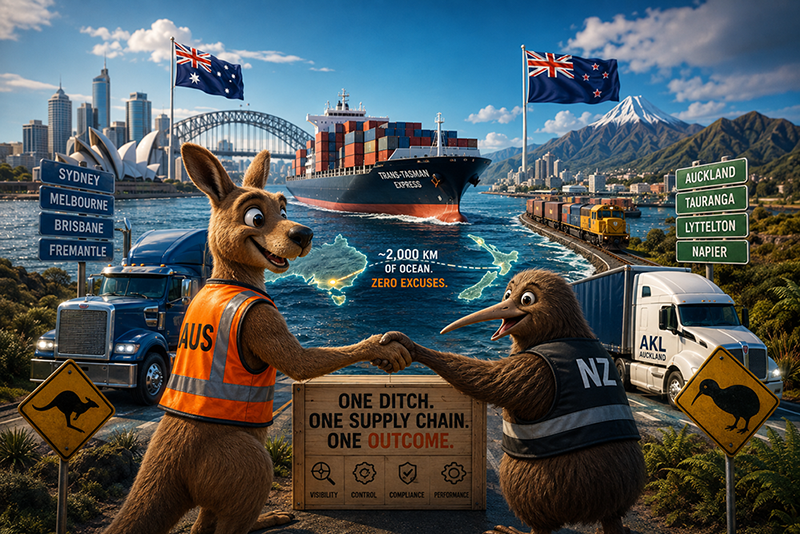
Trans-Tasman compliance and documentation: The customs playbook for Australia and New Zealand
Trans-Tasman Compliance: How to Stop Paperwork Becoming Freight.
Somewhere between the purchase order and the port, something tiny went rogue. The HS code was copied from an old shipment. The invoice says one thing while the Bill of Lading says something slightly different. Someone chose FOB because that’s what we always use. The timber pallet arrived with paperwork nobody can find. Or the perfectly innocent-looking product in Row 47 contains a lithium battery nobody thought was worth mentioning.
For three weeks, everything looked fine. The supplier was happy. The booking was confirmed. The truck arrived. The container sailed. Everyone moved on with their lives.
Then the freight stopped.
And suddenly Customs is apparently the villain.
It usually isn’t. The border is just where bad decisions run out of road.
That is the uncomfortable truth about Trans-Tasman compliance and documentation. Most customs problems are born long before Customs ever sees the freight. They’re born in procurement, product setup, supplier instructions, contracts, packaging, master data and the six-year-old spreadsheet called FINAL_TARIFF_CODES_v7_USE_THIS_ONE.xlsx.
By the time the problem reaches Australian Border Force, New Zealand Customs, DAFF or MPI, it has usually collected enough friends to become expensive.
And Australia-New Zealand freight is particularly good at creating a false sense of security. The two countries have spent decades removing barriers to trade. CER has been in force since 1983, qualifying goods can receive preferential tariff treatment, and the original compliance framework rightly identifies sophisticated customs systems, strict biosecurity regimes and trusted-trader arrangements on both sides of the Tasman.
It feels almost domestic.
Almost is doing some spectacularly heavy lifting there.
Because your freight still has to explain itself at an international border. What is it? Where did it actually originate? Who owns the risk? Who is responsible for clearance? What is it packed in? Does it contain anything regulated? Do the documents agree? And can you prove every answer you just gave?
An HS code answers what the product is for tariff purposes. Rules of origin determine whether preferential treatment can apply. Incoterms allocate particular responsibilities, costs and risks between buyer and seller. Bills of Lading document the carriage relationship. Biosecurity requirements care about what might have hitched a ride with your freight. Dangerous goods rules care about what is hiding inside it.
One shipment. Several government agencies. Eleven Incoterms. Multiple documents. Thousands of tariff classifications. And absolutely no regulatory category for “close enough”.
That is why customs compliance isn’t something that happens to your freight when it reaches the border.
It is something you build into the shipment before it leaves.
This is the Transport Works playbook for doing exactly that.

Trans-Tasman compliance and documentation: Why the paperwork is part of the freight
There is a wonderfully expensive habit in logistics where businesses negotiate freight rates to within an inch of their lives, then treat documentation as the administrative bit somebody can sort out later.
That logic works beautifully until later arrives.
A truck can collect the goods. A vessel can sail. A container can physically reach Auckland or Sydney. None of that means the inventory is commercially available. If Customs needs clarification, MPI needs evidence, DAFF requirements haven’t been met, the classification is questionable or the documents contradict each other, the freight has effectively arrived at a locked door.
And the key is sitting in somebody’s inbox.
The paperwork doesn’t move the freight. Until it stops it.
That is the bit traditional freight reporting tends to miss. We measure vessel departures, port arrivals and transit times because they are easy to see. Meanwhile, a document created ten days earlier can quietly determine whether the inventory moves tomorrow.
We call this Document Drift.
It starts innocently. Procurement has one description of the product. The ERP has another. The supplier’s invoice uses an abbreviation. The packing list has a different quantity. The freight forwarder receives an old consignee record. Someone uses last year’s tariff code because the product looks basically the same.
Individually, none of it feels catastrophic.
Together, you have four digital versions of one physical shipment heading towards a border authority that would quite reasonably like them to tell the same story.
That’s when paperwork becomes freight.
The discrepancy isn’t sitting in a filing cabinet anymore. It is sitting inside your lead time, landed cost, inventory availability and customer promise.
And probably somebody’s Friday afternoon.
The operational answer is not to become better at fixing documents after the shipment moves. It is to stop allowing unresolved questions into the transport chain.
Before the booking, you should know the classification. The origin. The Incoterm. The importer. The biosecurity requirements. The dangerous goods status. The permits and certificates required. The destination clearance process. And whether every document describes the same physical reality.
If the answer to any of those questions is “I think so”, you’re not ready.
“I think so” may be the most expensive unit of measurement in logistics.
Incoterms 2020: Three letters. Seventeen opinions. One invoice nobody wants to pay.
Incoterms have achieved something extraordinary. They contain only three letters and can still start a 45-minute argument between procurement, finance, sales and logistics.
The Incoterms 2020 rules are published by the International Chamber of Commerce and establish responsibilities between buyers and sellers in international transactions, including important points around costs, delivery and transfer of risk. The current edition contains 11 rules: EXW, FCA, CPT, CIP, DAP, DPU and DDP for any mode of transport, and FAS, FOB, CFR and CIF for sea and inland waterway transport. That's the textbook answer.
The useful answer is this:
Incoterms are arguments decided before there is something worth arguing about.
When freight goes wrong, somebody is paying. Somebody is carrying risk. Somebody arranged the carriage. Somebody is responsible for import or export formalities under the agreed structure. Somebody thought somebody else had organised insurance.
A correctly chosen Incoterm gives those responsibilities boundaries before the container develops a problem.
A badly chosen one gives everyone a meeting invitation.
Take EXW. It can look beautifully simple on a supplier quotation because the seller makes the goods available at its premises and the buyer takes on substantial responsibility from there. But complexity hasn't disappeared. It has simply crossed the table. The buyer now needs the capability to coordinate the origin-side movement and associated formalities.
EXW can remove cost from the supplier's quote without removing cost from your supply chain.
Then there's FOB, the old faithful of international freight. Everyone knows FOB. Everyone has used FOB. FOB probably has its own coffee mug in procurement.
But familiar doesn't automatically mean appropriate. The source material itself identifies the well-known tension around using FOB for containerised cargo, where physical custody can move into the terminal environment before the contractual FOB delivery point aboard the vessel. It notes FCA as an alternative worth considering for containerised movements.
Then there is CIF, where the seller pays specified freight and insurance costs to destination while risk transfers according to the rule at origin. That's the point that catches people: the party paying for the journey isn't necessarily carrying the risk for the entire journey.
And DDP can create the opposite illusion. It looks gloriously simple to the buyer because the seller assumes extensive obligations through to the named destination. But customer convenience doesn't eliminate complexity. It simply decides whose desk it lands on.
So stop asking, “Which Incoterm do we normally use?”
Ask, “Where do we actually want cost, control and risk to change hands?”
Then choose the rule.
Because FOB isn't a supply-chain strategy.
It's three letters desperately waiting for the rest of the sentence.
Bills of Lading: Your container has an identity crisis. Customs would prefer it didn’t.
A Bill of Lading is not exciting.
Neither is a passport until you're standing at immigration without one.
The source playbook describes a Bill of Lading as performing three important functions: receipt for the goods, evidence of the contract of carriage and, depending on its form, a document associated with title to the goods. It also distinguishes between the Master Bill of Lading (MBL) issued within the ocean carrier relationship and the House Bill of Lading (HBL) issued by a freight forwarder or NVOCC to its customer.
Why does that matter?
Because one physical container can sit inside multiple commercial relationships.
The shipping line has its relationship with the forwarder or NVOCC. The forwarder has its relationship with the exporter or importer. The paperwork reflects those layers.
And when everything matches, nobody particularly cares.
When it doesn't, everybody becomes a document expert at 4:47pm.
The source also identifies three release methods commonly encountered in Trans-Tasman shipping: original Bills of Lading, sea waybills and telex/express release arrangements.
This becomes especially relevant on a short international lane because the freight can move faster than traditional paperwork.
Your container should not win a race against the document required to release it.
So before sailing, don't simply ask which Bill of Lading is being issued. Ask what needs to happen at destination for the cargo to be released, who controls that process and whether anything physical still needs to travel.
Because discovering the answer while the container is already sitting there is an unnecessarily expensive way to learn maritime documentation.
HS codes: Ten tiny digits with access to your bank account
Most businesses see an HS code and think administration.
The border sees considerably more.
Every physical product crossing an international border is classified under the Harmonized System. The first six digits provide the international classification foundation, while Australia and New Zealand extend that system for domestic tariff and statistical purposes. The source research identifies Australia's import classification structure as extending to 10 digits and New Zealand's Working Tariff to 11 digits.
That tiny string of numbers can influence tariff treatment, permits, biosecurity requirements, trade-agreement eligibility, statistical treatment and compliance obligations.
Your product description tells the customer what you sell. Your tariff classification tells the border what you've actually brought into the country.
Those descriptions need to be friends.
The dangerous habit is treating HS classification like Google autocomplete. Type a product description. Find something that sounds close. Copy code. Carry on.
Except tariff classification isn't a game of closest wins. The source correctly identifies the General Rules for Interpretation as the framework governing classification decisions, including the legal wording of headings, section and chapter notes and rules for products potentially falling under multiple classifications.
This creates what we call the Classification Multiplier.
You make the classification decision once.
Then your supply chain repeats it.
Again.
And again.
And again.
Get it right and nothing particularly exciting happens, which in customs is generally excellent news.
Get it wrong on a high-volume SKU and one tiny master-data decision can reproduce itself across hundreds of declarations before anyone notices.
And CER adds another wrinkle.
Goods leaving Australia are not automatically Australian goods. Goods leaving New Zealand are not automatically New Zealand goods.
The source playbook correctly notes that CER preferential treatment depends on the applicable rules of origin. A foreign-origin product does not magically acquire Australian or New Zealand origin because it spent a few months sitting in a local warehouse contemplating citizenship.
Origin is something you establish.
Not something freight catches geographically.
Australian Trusted Trader and New Zealand Secure Exports Scheme: When compliance starts paying rent
Most businesses experience Customs shipment by shipment.
Trusted-trader programmes work on a more interesting premise.
What if the border already knows the business behind the box?
Australia operates Australian Trusted Trader (ATT), while New Zealand operates the Secure Exports Scheme (SES) for eligible exporters. The source research identifies both within the international Authorised Economic Operator framework and outlines mutual recognition between Australia and New Zealand.
The clever bit isn't simply faster processing.
It's the idea that compliance history can become operational capital.
A business invests in supply-chain security, governance, systems and regulatory discipline. Border agencies gain greater confidence in the operator. That trusted status can provide facilitation benefits under the applicable programme.
In other words, years of doing the boring stuff properly can eventually make the boring stuff easier. That's a decent return on boring.
But should every Trans-Tasman importer or exporter rush off and apply?
No.
The decision should depend on volume, trade profile, internal capability, border sensitivity, regulatory exposure and the actual value of programme benefits to the operation. The original draft proposes specific shipment thresholds for determining ROI, but those thresholds are Transport Works assumptions rather than established regulatory criteria, so I would not publish them as fact without supporting evidence.
The better question is:
How much does border uncertainty currently cost us, and how much of that could trusted-trader status realistically remove?
That's the calculation worth doing.
Biosecurity: Your $100,000 machine can be stopped by $0.00 worth of dirt
Now we reach the part of Trans-Tasman freight where something worth absolutely nothing can become astonishingly expensive.
Dirt.
A seed.
A splinter of untreated timber.
An insect that apparently decided Auckland looked nice this time of year.
Australia's BICON system sets out biosecurity import conditions for goods entering Australia, including whether imports are permitted and whether permits, treatment, documentation or other conditions apply.
New Zealand uses Import Health Standards to establish conditions for biosecurity-risk goods. The source identifies requirements affecting sea containers, vehicles and machinery, plant products, animal products, biological products and wood packaging, among other categories.
And this is where procurement's idea of the product and biosecurity's idea of the shipment can become two very different things.
Procurement sees a machine.
Biosecurity sees the machine, the mud underneath it, the timber holding it still and whatever crawled into the container while nobody was looking.
The expensive part of the shipment isn't always what you bought. Sometimes it's what came free.
We call that the Hitchhiker Problem.
Used machinery is a perfect example. The equipment itself may be entirely legitimate, but contamination can create biosecurity issues. Wood packaging can create another layer of requirements. Plant-derived packing materials can create another.
The source document identifies common problem areas including wooden packaging, exterior container contamination, undeclared organic material, second-hand machinery and mismatched documentation.
The operational lesson is beautifully simple.
Don't wait for the border to inspect something your supplier could have checked before loading.
Clean it. Check it. Photograph it where useful. Confirm packaging requirements. Get the required certificates. Make biosecurity part of supplier instructions.
Because MPI and DAFF shouldn't be the first people in your supply chain to notice what's stuck underneath the machine.
Dangerous goods: Surprise. You’re apparently in the chemicals business.
Dangerous goods have a branding problem.
The name makes everyone picture radioactive barrels glowing gently in a warehouse.
The reality can look remarkably normal.
Aerosols. Paint. Adhesives. Cleaning chemicals. Cosmetics with flammable components. Batteries. Battery-powered tools. Phones. Laptops. E-bikes. Power banks.
The original playbook identifies these as examples requiring consideration under dangerous-goods rules and sets out documentation requirements under the IMDG framework for relevant sea freight.
This is where product teams and transport regulations can appear to be discussing entirely different objects.
You sell headphones.
The transport system notices the lithium battery.
You sell hairspray.
The transport system notices the aerosol.
You sell nail polish.
The dangerous goods declaration has entered the chat.
Lithium batteries deserve particular attention. The source research identifies UN 3480 and UN 3481 for lithium-ion batteries in different shipping configurations and UN 3090/3091 for lithium-metal equivalents.
We call this the Battery Blind Spot.
The product catalogue describes what the customer buys.
Dangerous-goods regulation cares about what the product contains.
And those are not always the same conversation.
The time to discover that distinction is during product onboarding.
Not when the carrier rejects the shipment.
The Trans-Tasman documentation checklist: Stop booking freight with unanswered questions
By now we've accumulated enough acronyms to start a small government department.
So here's where all of it becomes operational.
The original playbook contains a strong shipment checklist covering commercial documents, transport documents, regulatory requirements, biosecurity documentation, dangerous-goods requirements and trusted-trader information.
But we would change one important thing.
Don't use the checklist at the end.
Use it as permission to begin.
Before commercial Trans-Tasman freight is booked, the business should have the appropriate commercial invoice and packing information, understand the transport document and release method, establish the correct tariff classification, determine whether permits or preferential-origin evidence are required, check applicable biosecurity requirements and identify dangerous goods before the carrier does.
Not every shipment requires every document. The exact requirements depend on the commodity, mode, value, country, packaging and regulatory treatment.
But every shipment should have the same rule:
Unanswered compliance questions don't get loaded onto a truck and sent towards a port.
We call it Clear-to-Book.
Because book now, solve later sounds efficient right up until later sends an invoice.
Frequently asked questions about Trans-Tasman compliance and documentation
What documents do I need to ship goods between Australia and New Zealand?
Commercial Trans-Tasman freight commonly requires a commercial invoice, packing list and transport document, such as a Bill of Lading or air waybill. Depending on the goods and direction of travel, you may also need customs declarations, tariff classifications, permits, certificates of origin or origin evidence, biosecurity documentation, treatment certificates and dangerous goods documentation.
For New Zealand sea-container imports, MPI specifically requires importers to consider the relevant Import Health Standard for both the container and its cargo, packaging requirements and documentation such as the quarantine declaration and, where applicable, BACC processes.
The important bit isn't having a folder full of documents. It's making sure every document tells the same story. A perfectly completed invoice is considerably less useful when the quantity, consignee, product description or classification disagrees with something further down the paperwork chain.
What are the most common Trans-Tasman customs documentation mistakes?
The expensive mistakes are often surprisingly small: incorrect tariff classifications, inconsistent product descriptions, incorrect consignee or importer details, missing biosecurity information, unsuitable wood packaging, unidentified dangerous goods, unsupported origin assumptions and documents that simply don't agree with each other.
Australian Border Force makes the classification responsibility particularly clear: importers must self-assess the correct tariff classification of imported goods, and penalties can apply for incorrect or misleading information.
Customs problems rarely begin at Customs. That's just where bad information finally meets somebody who refuses to pass it downstream.
Does CER mean I don't need customs documentation between Australia and New Zealand?
No. Preferential tariff treatment under the Australia-New Zealand Closer Economic Relations Trade Agreement does not remove customs, biosecurity, GST, classification, origin or documentation obligations.
This is one of the great Trans-Tasman traps. The commercial relationship between Australia and New Zealand is unusually close, so the freight can feel domestic.
The border remains stubbornly international.
Qualifying origin can affect tariff treatment, but the shipment still needs to satisfy the applicable import, export and regulatory requirements. In New Zealand, for example, all commercially imported goods must be cleared through NZ Customs, while biosecurity-risk goods must also meet applicable MPI requirements.
Which Incoterm is best for shipping between Australia and New Zealand?
There is no single best Incoterm for Trans-Tasman freight. The right Incoterm depends on where the buyer and seller want responsibility, cost and risk to transfer and which party is best positioned to control each part of the movement.
The bigger mistake is choosing EXW, FCA, FOB, CIF, DAP or DDP because "that's what we've always used."
Your Incoterm should reflect the actual commercial arrangement. If your operations team thinks the supplier is responsible for something the contract has quietly handed to you, you've already planted next month's argument.
Choose where you want responsibility to change hands first. Choose the three letters second.
Should I use FOB or FCA for containerised Trans-Tasman freight?
For containerised freight, FCA can be worth considering instead of automatically defaulting to FOB, because the physical handover of containerised cargo can occur before the goods are loaded aboard the vessel. The original research brief specifically identifies this as an area businesses should examine rather than treating FOB as an automatic choice.
That doesn't mean FCA is automatically correct for every shipment.
It means familiarity isn't a contractual strategy.
The Incoterm should match how the freight is actually handed over, who controls each stage and where the parties genuinely intend risk and responsibility to transfer.
What is the difference between a Master Bill of Lading and a House Bill of Lading?
A Master Bill of Lading (MBL) is issued within the ocean carrier's carriage relationship, commonly to a freight forwarder or NVOCC. A House Bill of Lading (HBL) may then be issued by that forwarder or NVOCC to its customer. They represent different contractual layers around the same physical freight.
Which sounds wonderfully administrative until the documents don't match.
Then one container effectively develops two identities and everyone becomes extremely interested in paperwork.
The physical freight should have one reality, even when multiple documents describe the commercial relationships surrounding it.
What is an HS code and why does it matter for Australia-New Zealand freight?
An HS code classifies goods for customs and trade purposes. Australia and New Zealand build their national tariff classifications on the international Harmonized System, and classification can affect tariff treatment, regulatory requirements, trade statistics and other border obligations.
In Australia, importers are legally responsible for self-assessing the correct tariff classification, and ABF provides a Tariff Advice System for advance rulings on goods intended for import.
Think of classification as master data with a passport.
Get one recurring SKU wrong and you haven't necessarily created one mistake. You've created a mistake capable of reproducing itself every time that SKU crosses the border.
Are goods shipped from Australia to New Zealand automatically Australian origin?
No. The country a shipment departs from and the origin of the goods are not automatically the same thing.
A product manufactured elsewhere and stored or distributed from Australia does not become Australian-origin simply because its next shipment leaves Melbourne or Sydney. Preferential tariff treatment under CER depends on satisfying the applicable rules of origin. The original research brief specifically flags this distinction for businesses moving foreign-origin products across the Tasman.
A warehouse is not a citizenship ceremony.
Origin needs to be established, supported and treated as a compliance question rather than inferred from the last postcode the product visited.
What are New Zealand's biosecurity requirements for imported freight?
New Zealand requires biosecurity-risk goods to comply with the relevant Import Health Standard (IHS) before they can receive biosecurity clearance. MPI states that IHS requirements apply to risk goods including plants, animal products and biological products, as well as other items such as sea containers and vehicles.
For sea containers, importers also need to consider the container IHS, cargo-specific requirements, packaging and required documentation. MPI states that sea containers must be accompanied by a quarantine declaration confirming they were inspected before export and are free from contamination.
This is why biosecurity can't be left until arrival.
MPI shouldn't be the first person in your supply chain to discover what is stuck underneath the machine.
Can wooden pallets and packaging cause Trans-Tasman biosecurity problems?
Yes. Wood packaging, dunnage and other packing materials can carry biosecurity risk and may be subject to destination-country requirements.
MPI specifically tells importers of containers and cargo to consider requirements for wood and other packaging, alongside the requirements applying to the container and the cargo itself.
The commercial lesson is bigger than pallets.
Businesses naturally focus on the product because that's the thing they paid for. Biosecurity also cares about what travelled with it.
A six-figure machine can therefore be delayed by dirt, timber, plant material or contamination worth precisely $0.
Sometimes the cheapest thing in the container is the most expensive thing to import.
What is Australian Trusted Trader?
Australian Trusted Trader (ATT) is Australia's Authorised Economic Operator programme for businesses that meet specified supply-chain security and trade-compliance requirements.
For businesses trading across the Tasman, the broader strategic idea is worth understanding: strong compliance can become an operational asset rather than simply an obligation.
New Zealand operates its own AEO programme, the Secure Exports Scheme (SES), and NZ Customs confirms that Australia is one of the countries with which New Zealand has a Mutual Recognition Arrangement.
In other words, doing the boring stuff properly can eventually make some of the boring stuff easier.
What is New Zealand's Secure Exports Scheme?
The Secure Exports Scheme (SES) is New Zealand Customs' Authorised Economic Operator programme. It certifies eligible exporters and supply-chain partners that meet Customs' secure supply-chain requirements.
NZ Customs says the scheme is designed to improve supply-chain security while helping exporters achieve greater certainty at international borders. Membership requires businesses and relevant supply-chain partners to meet defined security standards.
The important strategic shift is this:
Compliance stops being something you prove shipment by shipment and starts becoming something the supply chain itself is designed to demonstrate.
How do I know if my Trans-Tasman shipment contains dangerous goods?
Don't decide based on whether the finished product looks dangerous.
Products containing lithium batteries, aerosols, flammable liquids, paints, adhesives, chemicals and some cosmetics or cleaning products can fall within dangerous-goods transport requirements depending on their composition, quantity, packaging and mode of transport. The original compliance brief specifically identifies these product categories and lithium battery classifications as areas requiring attention.
The safest operational question during product onboarding is therefore not simply:
"What do we sell?"
It is:
"What is inside what we sell?"
Your customer may have bought headphones.
The transport system may have just met a lithium battery.
When should customs and biosecurity requirements be checked?
Not when the container reaches the terminal. Not when the vessel is two days from Auckland. And definitely not when somebody forwards an email titled URGENT CLEARANCE REQUIRED with 14 people copied in.
Classification, origin, Incoterms, importer responsibilities, permits, biosecurity conditions, packaging requirements and dangerous-goods status should be understood early enough to change the shipment if necessary.
MPI's own process reflects this principle: importers are expected to identify the relevant Import Health Standards, cargo requirements, packaging requirements and required documentation as part of preparing the import.
At Transport Works, we'd describe that as Clear-to-Book.
Get the questions out of the freight before you put the freight on the water.
Who is ultimately responsible for correct customs documentation?
Responsibility depends on the particular obligation, transaction structure, country and parties involved, but outsourcing freight forwarding or customs brokerage does not make accurate source information somebody else's problem.
For example, ABF explicitly states that Australian importers are required to self-assess the correct tariff classification of their imported goods and that penalties may apply for incorrect or misleading information.
Your customs clearance partner can be brilliant.
They still cannot reliably classify, declare or clear a product using information your business never gave them.
You can outsource the process. You can't outsource the truth.
What is the best way to prevent Trans-Tasman customs delays?
There isn't one magic document.
The strongest defence is consistency before movement: establish the correct tariff classification and origin, choose Incoterms deliberately, identify biosecurity and dangerous-goods requirements, confirm permits and certificates, make sure commercial and transport documents agree, and understand the destination clearance and release process before booking.
That's the pattern running through this entire guide.
Most businesses try to make customs clearance faster.
The better operators give Customs fewer reasons to stop the freight in the first place.
That is a very different logistics strategy.
The real cost of Trans-Tasman compliance isn't compliance
Here is the part businesses get backwards.
Compliance is often treated as friction.
More checking. More documentation. More process. More people asking annoying questions before the shipment can move.
But compare that with the alternative.
One correctly prepared shipment requires the right classification, documents, declarations and checks.
One badly prepared shipment requires all of those things plus investigation, amendment, escalation, storage, inspections, possible treatment, rescheduling, management attention, customer explanations and somebody digging through emails looking for the attachment everyone swears was sent on Tuesday.
Good compliance creates work once. Bad compliance creates work everywhere.
And that is the bigger strategic lesson hiding inside Trans-Tasman compliance and documentation.
The border is not the end of your supply chain.
It is one of the participants in it.
So Customs shouldn't be where you discover what you've shipped.
MPI shouldn't be where you discover what it was packed in.
DAFF shouldn't be where you discover what was stuck to it.
The carrier shouldn't be where you discover it contains dangerous goods.
And your customer definitely shouldn't be where you discover nobody owned the gap between all four.
The best Trans-Tasman shipments can look almost boring.
The classification is right. The origin is understood. The Incoterm reflects the actual commercial arrangement. The invoice, packing list and transport documents agree. Biosecurity was considered before packing. Dangerous goods were identified before booking. The border receives what it expects.
The freight keeps moving.
Nobody becomes famous on Teams.
That isn't paperwork working well.
That's the supply chain working well.
And that is ultimately what compliance is supposed to do.
Get the questions out of the freight before you put the freight on the water.
Want to know what else can happen while your freight is crossing the ditch? Read:
The Brains Behind Tasman Freight
Local Chaos. Trans-Tasman Control.
INSIGHTS FROM DANYUL GLEESON, FOUNDER, CLUSTER-FREIGHT-FIXER & LOGISTICS CHAOS TAMER-IN-CHIEF AT TRANSPORT WORKS
Danyul has been in the trenches - warehouses where pick paths were sketched on pizza boxes and boardrooms where the “supply chain strategy” was a shrug. He built Transport Works to flip that script: a 4PL that turns broken systems into competitive advantage. His mission? Always Delivering - without the chaos.
Sources & References
Incoterms 2020 and International Trade Responsibilities
International Chamber of Commerce (ICC) – Incoterms® 2020
Used to support the definition and application of Incoterms® 2020, including the 11 rules and their allocation of costs, risks and obligations between buyers and sellers in international trade.
International Chamber of Commerce (ICC) – Incoterms® Rules
Referenced for the history and purpose of Incoterms®, including their role in clarifying the tasks, costs and risks involved in the delivery of goods between sellers and buyers.
Tariff Classification, HS Codes and Australian Customs
Australian Border Force (ABF) – Tariff Classification
Used to support discussion of Australian tariff classification responsibilities, including ABF's requirement that importers self-assess the correct tariff classification of imported goods and the availability of tariff advice for goods intended for import.
Australian Border Force (ABF) – Current Working Tariff
Referenced for Australia's current Combined Australian Customs Tariff Nomenclature and Statistical Classification and its relationship with the international Harmonized System.
New Zealand Tariff Classification and Customs
New Zealand Customs Service – Working Tariff Document of New Zealand
Used to support New Zealand tariff classification, tariff schedules, concessions and the current Working Tariff framework. The current online material includes updates effective in 2026.
New Zealand Customs Service – Tariff Classifications and Rates
Referenced for the requirement that New Zealand importers identify the appropriate tariff classification, duty rate and applicable concessions for imported goods.
CER and Trans-Tasman Rules of Origin
Australian Government Department of Foreign Affairs and Trade (DFAT) – Australia-New Zealand Closer Economic Relations Trade Agreement (ANZCERTA)
Used to support the Trans-Tasman trade framework and the application of CER to trade in goods between Australia and New Zealand.
Australian Government Department of Foreign Affairs and Trade (DFAT) – ANZCERTA Article 3: Rules of Origin
Referenced for the rules used to determine whether goods qualify as originating under ANZCERTA, including the Change of Tariff Classification approach and treatment of wholly obtained goods.
Australian Government Department of Foreign Affairs and Trade (DFAT) – Trade in Goods under ANZCERTA
Used for historical and regulatory context around Trans-Tasman preferential trade, customs procedures and rules governing entitlement to preferential rates of duty.
Australian Trusted Trader
Australian Border Force (ABF) – Australian Trusted Trader
Used to support the explanation of Australian Trusted Trader as Australia's trusted-trade programme, including eligibility, supply-chain security and trade-compliance requirements and available trade-facilitation benefits.
Australian Border Force (ABF) – Benefits of Being an Australian Trusted Trader
Referenced for ATT benefits including priority processing, priority treatment at the border, account management, consolidated cargo clearance, monthly cargo data reporting and international recognition.
Australian Border Force (ABF) – Mutual Recognition Arrangements Used to support the discussion of international recognition of Australian Trusted Trader status, including Australia's Mutual Recognition Arrangement with New Zealand Customs Service.
New Zealand Secure Exports Scheme
New Zealand Customs Service – Secure Exports Scheme (SES)
Used to support the explanation of SES as New Zealand's World Customs Organization-aligned Authorised Economic Operator programme and its role in secure international supply chains.
New Zealand Customs Service – What Is the Secure Exports Scheme?
Referenced for the purpose of SES, including improving border certainty, reducing the risk of delays and providing overseas customs authorities with greater confidence in participating New Zealand export supply chains.
New Zealand Customs Service – Australia and New Zealand Sign Arrangement to Streamline Trade
Used to support the Trans-Tasman Mutual Recognition Arrangement between Australian Trusted Trader and New Zealand's Secure Exports Scheme and the resulting customs facilitation for recognised exporters.
New Zealand Customs Service – SES Security Standards
Referenced for the operational requirements behind SES, including site security, personnel controls, container packing and loading, seals, quality assurance, digital security and supply-chain reporting.
Australian Biosecurity and BICON
Australian Government Department of Agriculture, Fisheries and Forestry (DAFF) – Biosecurity Import Conditions System (BICON)
Used throughout the blog to support discussion of Australia's biosecurity import requirements, including whether goods are permitted, require supporting documentation, require treatment or need an import permit.
Australian Government Department of Agriculture, Fisheries and Forestry (DAFF) – BICON Import Permits
Referenced for Australian biosecurity import-permit requirements, including the requirement that permits applying to relevant commodities be granted before the goods arrive in Australia.
New Zealand Biosecurity and Import Health Standards
New Zealand Ministry for Primary Industries (MPI) – Import Health Standards
Used to support the explanation that biosecurity-risk goods imported into New Zealand require compliance with the applicable Import Health Standard under the Biosecurity Act 1993. MPI identifies risk categories including plants, animal products, food and biological products, as well as sea containers and vehicles.
New Zealand Ministry for Primary Industries (MPI) – Sea Containers from All Countries: Import Health Standard
Referenced for New Zealand's specific biosecurity controls applying to imported sea containers, including contamination and quarantine requirements.
New Zealand Ministry for Primary Industries (MPI) – Vehicles, Machinery and Parts Import Health Standard
Used to support the blog's discussion of biosecurity risks associated with imported machinery, equipment and parts, particularly contamination that may travel with otherwise legitimate freight. MPI's current listing shows this standard was updated in May 2026.
Dangerous Goods and IMDG Documentation
International Maritime Organization (IMO) – International Maritime Dangerous Goods (IMDG) Code
Used to support the dangerous-goods section covering the international requirements for transporting dangerous goods by sea. The IMDG Code 2024 Edition incorporating Amendment 42-24 became mandatory on 1 January 2026.
International Maritime Organization (IMO) – Amendments to the International Maritime Dangerous Goods Code
Referenced for the classification and treatment of lithium batteries within the IMDG framework and the broader regulatory requirements applying to dangerous goods transported by sea.
Disclaimer:
The information in this blog is provided for general informational purposes only and is current as of the date of publication. Customs duties, charges, processes, policies, and rates are subject to change at any time without notice. We make no representations or warranties of any kind, express or implied, about the completeness, accuracy, reliability, suitability, or availability of the information contained in this article. You should not rely on this content as a substitute for official sources. For the most up-to-date and authoritative information, please consult the relevant government agencies, customs authorities, and reference websites directly. Ideas, interpretations, and opinions expressed here are subject to change as regulations, markets, and industry practices evolve. Transport Works and its authors accept no liability for any loss or damage whatsoever arising from reliance on the information in this blog.