
Trans-Tasman Freight: The ultimate guide to shipping between Australia and New Zealand
Updated: Sep 3
THE TASMAN IS ONLY 2,000-ODD KILOMETRES WIDE.
IT HAS AN EXTRAORDINARY TALENT FOR MAKING THOSE KILOMETRES EXPENSIVE.
Australia and New Zealand have been trading tariff-free on qualifying goods for decades. The major ports are separated by days, not weeks. The carriers know the route. The customs systems know each other. We even call it across the ditch, as though your container just needs to roll up its trousers and hop over.
And that is precisely why Trans-Tasman freight catches so many businesses out.
Because this lane looks easy.
Until your five-day sailing becomes a ten-day inventory problem. Until the cheapest freight rate grows tentacles: terminal handling, documentation, customs clearance, biosecurity, GST, delivery, detention and demurrage. Until a container arrives in Auckland but the stock inside it is still several operational decisions away from being stock you can actually sell.
Or until someone discovers that tariff-free and friction-free are two very different things.
That is the peculiar reality of shipping between Australia and New Zealand.
The ocean isn't necessarily the problem. Everything attached to it can be.
And after enough Trans-Tasman freight, you start noticing a pattern.
The businesses that manage this lane well don't obsess over shaving another few dollars off the ocean rate. They know which sailing works for their inventory. They know when FCL beats LCL and when it absolutely doesn't. They know where transit time really disappears. They know what biosecurity can do to an innocent-looking pallet. And they calculate the cost of the whole movement, not the seductive little number sitting beside "ocean freight" on a quote.
Because the cheapest container across the Tasman can become a remarkably expensive place to store inventory.
This guide is about Trans-Tasman freight as it actually behaves.
The routes. The real transit times. Sea freight versus air freight. FCL versus LCL. Customs. GST. Biosecurity. Ports. Costs. Carriers. And the small operational decisions that have an irritating habit of becoming large commercial ones.
Whether you're shipping Australia to New Zealand, New Zealand to Australia, or trying to work out why something travelling such a short distance has become such a spectacular pain in the arse...
Welcome to the ditch.
Let's show you where the money, time and headaches actually go.
TL;DR
The Tasman is only 2,000-odd kilometres wide.
Your freight can still find an astonishing number of ways to get lost in the details.
Sea or air. FCL or LCL. Customs. Biosecurity. GST. Cut-offs. Ports. Transit times that look fabulous until someone mistakes port-to-port for actually-in-the-warehouse.
Because Trans-Tasman freight isn’t really about getting something from Australia to New Zealand.
It’s about getting inventory from ready-to-go to ready-to-sell without the cheap option developing tentacles.
What is Trans-Tasman freight?
Trans-Tasman freight is the movement of goods between Australia and New Zealand by sea freight, air freight or roll-on/roll-off shipping.
That's the technically correct answer. It's also a bit like describing a Formula 1 race as cars going around a track. Accurate. Spectacularly unhelpful.
Because the actual Trans-Tasman freight journey isn't Sydney to Auckland. Or Melbourne to Tauranga. Or Auckland to Brisbane.
It's ready-to-go to ready-to-sell.
A shipment can move through collection, consolidation, port handling, export processes, vessel cut-offs, international freight, customs clearance, biosecurity, terminal handling, deconsolidation, warehousing and final delivery before anybody gets to call the job finished.
The ship crossing the Tasman is merely the most visible bit.
The 2,000-kilometre illusion
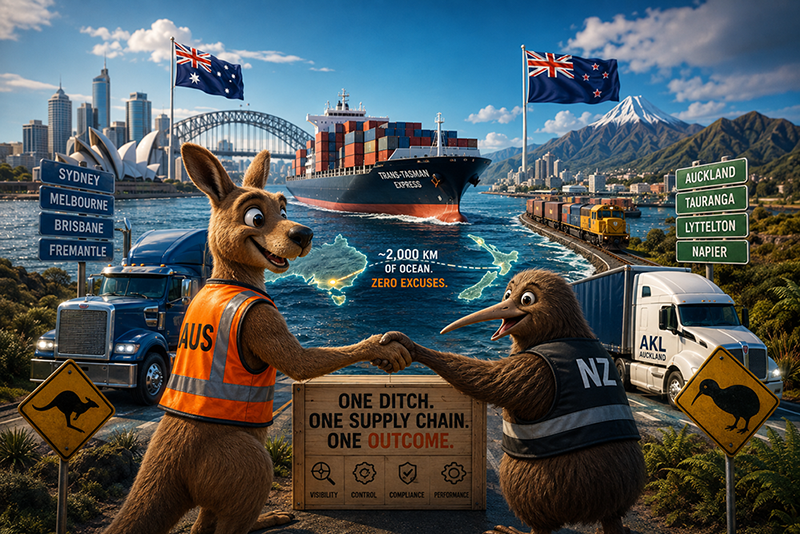
At its shortest major crossing, the Tasman is roughly 2,000 kilometres of ocean. Close enough to feel simple. Far enough away to require an international supply chain.
That's the trap.
Businesses naturally give the ocean most of their attention because it's the big blue thing in the middle. But distance isn't always what makes Trans-Tasman freight slow, expensive or unpredictable.
Sometimes the freight moves beautifully. Then it waits. For consolidation. The vessel. Clearance. Biosecurity. Deconsolidation. Delivery. Or somebody, somewhere, to decide what happens next.
A container can cross the Tasman faster than an organisation can cross an inbox.
Port-to-port transit tells you how long the vessel takes. Useful. But your warehouse doesn't replenish itself when the ship docks. Your production line doesn't care that the vessel arrived on Tuesday if the materials aren't available until Friday. And your customer certainly isn't standing at the Port of Auckland applauding the container's punctual arrival.
They care about when the product becomes usable.
That is why the useful question isn't simply, "How quickly can we get from Australia to New Zealand?"
It's:
"How reliably can we get inventory from where it is now to where the business actually needs it, at the true landed cost we expected?"
Tiny difference in wording. Massive difference in what you end up managing.
Why Trans-Tasman freight is different from almost every other international route
Australia and New Zealand have spent decades making it easier to trade with each other.
Then they put two highly protective island biosecurity systems on either side of the freight lane.
Welcome to the wonderfully contradictory world of Trans-Tasman freight.
Under the Australia-New Zealand Closer Economic Relations Trade Agreement, qualifying goods can move between the countries without tariffs. CER came into effect in 1983, and by 1990 all tariffs and quotas had been eliminated, five years ahead of schedule. DFAT says two-way Trans-Tasman merchandise trade has grown at an average annual rate of around 8% following CER's adoption.
On paper, it's about as friendly as international trade gets.
At the border, friendship has paperwork.
The border is open to trade. Not surprises.
New Zealand's Ministry for Primary Industries requires importers to comply with container and cargo Import Health Standards, packaging requirements and relevant documentation. MPI recommends container information be submitted at least 12 hours before arrival.
Containers may be checked for documentation, pests, diseases, soil and other contaminants.
Australia maintains its own biosecurity controls. Food is a particularly interesting example of how integrated the two economies have become: most food imported from New Zealand is exempt from Australia's routine imported-food inspection and testing because the countries share food standards and recognise each other's regulatory systems. There are still specific exceptions, and biosecurity requirements continue to apply.
This creates what we think of as the Familiarity Tax.
Not an actual government charge. An operational one.
It's the cost created when a business treats a familiar freight lane as a simple freight lane.
Documentation gets left late. Biosecurity gets checked after the booking. GST gets separated from the freight decision. Port-to-port transit gets mistaken for inventory availability. The cheapest rate wins without anyone asking what happens at either end.
Individually, these look like small decisions.
Collectively, they're how a straightforward shipment develops a personality disorder.
The freight feels local long before the border agrees.
The trade agreement behind Trans-Tasman freight: CER explained
If Trans-Tasman freight feels unusually connected, there's a reason.
Australia and New Zealand have been dismantling barriers between their economies for more than four decades.
The Australia-New Zealand Closer Economic Relations Trade Agreement (ANZCERTA or CER) became the cornerstone of the bilateral economic relationship in 1983. Its predecessor had already removed tariffs and quantitative restrictions on around 80% of Trans-Tasman trade by the late 1970s, but CER went much further.
By 1990, tariffs and quotas between the two countries had been eliminated. Later agreements pushed integration further through services, food standards, mutual recognition and investment.
That's the history lesson.
Here's the part your supply chain cares about.
CER removes a wall. It doesn't remove the doorway.
Qualifying goods may receive tariff-free treatment, but they still need to be correctly classified. Rules of origin still matter. Import declarations still matter. GST still matters. Biosecurity still matters.
This distinction sounds boring right up until somebody's landed-cost model assumes zero tariff = zero border cost.
Then it becomes extremely interesting.
The strategic advantage of CER isn't that businesses can stop thinking about the border. It's that, when the border is managed properly, Australia and New Zealand can function as an unusually connected commercial market.
That's a much more valuable proposition.
Trans-Tasman shipping routes: the shortest route isn't always the smartest route
Pull up a map and Trans-Tasman freight looks beautifully obedient.
Sydney points at Auckland.
Melbourne points at Auckland.
Brisbane points at Tauranga.
Perth looks over from the other side of the continent wondering why everybody forgot it was invited.
Unfortunately, supply chains aren't drawn with rulers.
The main Australian gateways include Sydney, Melbourne, Brisbane and Fremantle, while major New Zealand gateways include Auckland, Tauranga and Lyttelton, with other services connecting ports including Napier, Nelson and Port Chalmers. Current route information from Röhlig identifies Sydney, Melbourne and Brisbane to Auckland/Tauranga as high-frequency corridors, with Melbourne/Sydney to Lyttelton important for South Island freight.
ANL's Trans-Tasman network was also revised in August 2026, with a rotation through Sydney, Melbourne, Auckland, Lyttelton, Nelson, Port Chalmers, Napier, Tauranga, a second Auckland call and back to Sydney. ANL says the change was designed to improve reliability, operational efficiency and connectivity.
But here's where route planning gets more interesting than drawing lines between ports.
The nearest port to your customer is not automatically the best port for your supply chain.
Frequency matters.
Cut-off matters.
The day your inventory becomes available matters.
Carrier rotation matters.
The destination warehouse matters.
The cost and reliability of the domestic leg matter.
And whether your freight needs to arrive on Thursday or simply "sometime next week" matters enormously.
A sailing that saves one day at sea but adds three days waiting for departure hasn't saved anything.
We call this the Calendar Trap.
Businesses often compare freight routes using transit time.
Operators compare them using usable days.
If one service sails Friday and another sails Tuesday, the theoretically faster vessel may already have lost before anybody unties a rope.
So when comparing Auckland-Sydney freight, Melbourne-Auckland freight, Brisbane-Tauranga freight or Sydney-Lyttelton freight, don't ask only which route is fastest.
Ask which route produces the most reliable inventory availability date.
That's the date your business can actually spend.
Trans-Tasman transit times: where the missing days go
This is one of the most searched questions about shipping between Australia and New Zealand. And one of the easiest to answer badly.
Current published schedules show how short the ocean leg can be. For example, Röhlig listed a late-July 2026 Sydney departure reaching Auckland roughly five days later, while a Melbourne-Auckland example was approximately four days. Actual schedules change, so these should be treated as examples rather than promises.
Which sounds fantastic.
Until someone turns five days port-to-port into five days door-to-door in the inventory plan.
Those are not the same thing.
Before the sailing there may be pickup, consolidation, export processing and a vessel cut-off. After arrival there may be customs, biosecurity, terminal handling, deconsolidation and final delivery.
LCL introduces another clock because your freight is sharing space. The container needs to be consolidated before departure and unpacked after arrival.
Suddenly the five-day voyage has acquired a supporting cast.
The Transit-Time Iceberg
The sailing is the bit everybody can see.
The waiting around it is underwater.
And that's why we prefer to separate three clocks:
Sailing time: How long is the vessel actually moving between ports?
Door-to-door time: How long from collection to delivery?
Inventory availability time: When can the business actually use, sell or distribute the stock?
That third number is often the one management needed in the first place.
Because fast freight that isn't available isn't fast freight.
Sea freight, air freight or RORO: choose the problem before you choose the mode
There is no universally "best" way to ship freight between Australia and New Zealand.
There is only a mode that fits the commercial problem you're trying to solve.
Sea freight
Sea freight is the workhorse for regular palletised, containerised and higher-volume Trans-Tasman movements. It gives businesses access to FCL and LCL options and usually makes the most sense where inventory can tolerate the additional lead time.
But "sea is cheaper" is an incomplete sentence.
Cheaper than what?
If slower replenishment creates a stockout, forces additional safety stock or causes an urgent airfreight recovery next week, today's cheap sea freight can send tomorrow an invoice.
Air freight
Air freight changes the equation when the value of time exceeds the additional freight cost.
High-value goods. Critical parts. Perishables. Launch stock. Production shortages. Customer emergencies.
The mistake is treating air freight as automatically expensive rather than asking what delay costs. A $4,000 airfreight decision that prevents a $40,000 production interruption isn't expensive freight.
It's cheap insurance with wings.
Roll-on/roll-off freight
RORO has a specialist role for vehicles, wheeled machinery and equipment that can be driven or towed aboard suitable vessels.
Again, the decision shouldn't begin with mode.
It should begin with the cargo, urgency, handling requirements, risk, volume and consequence of delay.
Mode is an operational decision. Its consequences are commercial.
FCL vs LCL freight between Australia and New Zealand
The usual explanation goes like this:
FCL means Full Container Load.
LCL means Less than Container Load.
Thank you for attending logistics kindergarten.
The question businesses actually need answered is:
At what point does sharing a container stop saving money?
FCL gives you exclusive use of the container. LCL lets you buy only the space you need.
For smaller shipments, LCL can be extremely efficient. But you're also buying into the consolidation process. Your freight waits for other freight before departure and meets it again during deconsolidation.
FCL generally gives businesses more control over the unit, fewer cargo touches and a simpler container journey, but paying for empty air isn't a strategy either.
This is why rigid rules such as "always switch at X cubic metres" can be dangerous. Shipment density, dimensions, origin and destination charges, frequency, handling, commodity and current market rates all change the crossover point.
The real question isn't FCL or LCL. It's:
What are we optimising?
Lowest freight cost?
Fastest availability?
Lowest handling risk?
Cash flow?
Inventory frequency?
Supplier consolidation?
Because there is another option hiding between the acronyms.
A business buying from multiple Australian suppliers may be able to consolidate purchase orders into a planned FCL movement, capturing container economics without requiring any one supplier to fill the box.
That's when freight stops being procurement by shipment and starts becoming network design.
Trans-Tasman freight costs in 2026: the rate is not the cost
This is where freight quotes become dangerous little documents.
They look complete.
They have numbers.
Sometimes they even say ALL-IN in reassuring capital letters.
Then the invoices start breeding.
The original guide included indicative mid-2026 ocean rates, but freight prices move with carrier capacity, fuel, surcharges, equipment, routing, seasonality and market conditions. A static rate published in a long-life guide can become stale remarkably quickly.
So instead of giving you a number that may be wrong when you read this, here's the model that matters.
Your Trans-Tasman freight cost has layers
Depending on the movement, your landed cost may include:
origin pickup
ocean or air freight
fuel or bunker adjustments
terminal handling
documentation
customs brokerage
government processing charges and levies
biosecurity charges
inspections or treatments where required
GST
destination handling
deconsolidation
storage
final-mile delivery
detention or demurrage
exception and recovery costs.
Australia's current Import Processing Charges, for example, vary according to consignment value and declaration method. For electronic declarations, ABF currently lists
A$50 for consignments over A$1,000 but under A$10,000, and A$152 for consignments of A$10,000 or more.
New Zealand changed its border goods levies from 1 April 2026. For a high-value sea import, NZ Customs currently lists a combined Customs and MPI goods levy of NZ$118.44 excluding GST.
Neither number is enormous by itself.
That's the point.
Supply chains rarely get expensive through one magnificent charge. They get expensive through twenty reasonable ones that nobody added together.
We call the difference between the freight quote and the economic reality the Rate Illusion.
And the cure is landed-cost visibility.
Customs clearance: New Zealand to Australia
Shipping from New Zealand to Australia benefits from CER, but the Australian border still expects you to know what you're importing.
For goods valued over A$1,000, ABF says an Import Declaration is generally required and duties, taxes and applicable charges are assessed at the border. For goods at or below A$1,000, there are generally no duties, taxes or charges collected at the border, although Australia's low-value GST rules mean eligible overseas sellers and marketplaces may collect GST at the point of sale.
Commercial shipments typically require the appropriate commercial invoice, packing information and transport documentation, with additional permits or evidence depending on the commodity.
And CER doesn't make tariff classification optional.
Zero duty on a qualifying product is still a customs outcome. It isn't permission to guess the code.
This is one of those areas where boring accuracy is considerably cheaper than creative interpretation.
Customs clearance: Australia to New Zealand
Coming the other direction, NZ Customs and MPI share the border stage.
Import information is handled electronically through New Zealand's border systems, and MPI recommends relevant container information be submitted at least 12 hours before arrival to reduce the risk of delays. Required information can include the container number, origin, loading and discharge ports, cargo and packaging description, quarantine declaration, tariff code, importer/exporter information and transitional-facility destination.
That's a useful checklist.
But the operational lesson is bigger.
Border clearance should begin before the freight does.
If your team starts discovering certificates, classifications and biosecurity requirements when the vessel is already approaching New Zealand, you haven't got a customs problem.
You've got a planning problem wearing a customs costume.
Biosecurity: where Trans-Tasman freight stops being casual
If there is one part of Trans-Tasman freight that deserves considerably more respect than it often gets, it is biosecurity.
New Zealand's MPI checks arriving containers for correct documentation, pests, diseases and contamination including soil and other biological material. Serious contamination can result in treatment, identification of organisms, reshipment or destruction, with the importer liable for associated costs. Read that last part again.
A little dirt isn't always a little dirt when it arrives on an island with an agricultural economy and protected ecosystem.
This is why used machinery, timber packaging, plant products, food, animal products and other risk goods need to be understood before loading, not after arrival.
Wood packaging may also need to meet applicable import requirements. Cargo-specific Import Health Standards can require particular certificates, treatments or other evidence.
Biosecurity has no sense of humour
This is one place where the Transport Works advice is wonderfully boring:
Clean it.
Check it.
Document it.
Certify it.
Then check it again.
Because the cheapest biosecurity hold is the one that never happens.
The pattern experienced operators recognise is that biosecurity problems often begin much earlier than the border. They begin with supplier instructions. Packaging decisions. Cleaning standards. Missing documentation. Somebody assuming a pallet is "just a pallet".
The border merely discovers the mistake.
GST, duty and low-value thresholds: tariff-free does not mean tax-free
This is probably the most persistent misunderstanding in Trans-Tasman freight.
CER and GST are not the same conversation.
Importing into Australia
For taxable imports into Australia, GST is 10% of the Value of the Taxable Importation (VoTI). ABF defines VoTI as including the customs value, international transport and insurance where applicable, customs duty and certain other taxes.
For lower-value consumer imports, different collection mechanisms can apply, including GST collected by eligible overseas vendors or marketplaces at the point of sale.
Importing into New Zealand
New Zealand GST is 15%. NZ Customs calculates GST using the customs value plus applicable duty and international freight and insurance. New Zealand's current low-value framework uses a NZ$1,000 threshold, with overseas suppliers potentially collecting GST on qualifying lower-value goods.
So yes, qualifying Australian or New Zealand origin may remove tariff.
No, that does not make the border free.
And if your margin calculation forgets GST, freight, insurance, levies and clearance because somebody started with the supplier invoice and stopped thinking...
the margin didn't disappear.
It was never there.
Port performance and reliability: your shipment inherits everyone else's problems
A Trans-Tasman vessel doesn't live in a Trans-Tasman bubble.
Ships arrive from somewhere.
Ports handle other trades.
Berthing windows move.
Networks bunch.
Connections miss.
Weather happens.
Equipment moves.
A delay upstream can wander into your beautifully planned Sydney-Auckland shipment without asking permission.
That's why schedule reliability should never be treated as a carrier brochure metric.
It is an inventory variable.
ANL's July 2026 announcement is a useful real-world example. The carrier changed its Tranztas rotation and berthing windows from August specifically to improve schedule reliability, operational efficiency, transit times and connectivity, including adding a second Auckland call.
That tells us something important.
Routes are not fixed infrastructure.
They're living networks.
Reliability beats theoretical speed
If Service A promises four days but regularly disrupts your receiving plan, while Service B takes five and behaves predictably, the second service may be operationally faster.
Why?
Because businesses don't run on averages.
They run on Tuesdays.
A warehouse books labour for Tuesday.
A promotion launches Tuesday.
A production line needs material Tuesday.
A customer was promised Tuesday.
Variability is where logistics turns into business risk.
So don't just measure average transit time across your Trans-Tasman freight.
Measure variance.
Measure late arrivals.
Measure clearance time.
Measure days from discharge to availability.
Measure how often somebody needs to intervene.
The average tells you what usually happened.
The exceptions tell you what your supply chain actually costs to operate.
How to choose a Trans-Tasman freight partner
This section normally becomes a beauty pageant.
"Choose an experienced provider."
"Look for great customer service."
"Make sure they understand your business."
Lovely.
Now let's talk about what actually matters.
1. Can they operate both sides of the Tasman?
You don't need two disconnected forwarding relationships exchanging emails across an ocean. You need operational continuity.
Ask who owns the shipment in Australia. Who owns it in New Zealand. Who manages the handover. Who sees the exception. And, most importantly, who gets out of bed when it goes wrong.
2. Do they understand customs and biosecurity before the border?
The question isn't whether your provider can clear freight.
It's whether they can identify what could prevent it being cleared before you ship it.
That's a very different capability.
3. Are they mode-neutral and carrier-neutral?
If every problem mysteriously has the same solution, there's a fair chance you're being sold inventory rather than strategy.
Your freight partner should be able to compare carriers, routes, FCL, LCL, air freight, RORO and consolidation based on the outcome your business needs.
Not based on what they happen to have available this week.
4. Can they show you the whole movement?
Tracking dots are nice.
Decision visibility is better.
Where is the freight?
Is it on plan?
If not, why?
What is the commercial consequence?
Who owns the exception?
What happens next?
A control tower should reduce the amount of detective work your team performs, not give them a prettier place to begin investigating.
5. Can they explain the whole cost?
Ask to see the landed-cost anatomy.
Freight.
Origin.
Destination.
Border.
Biosecurity.
Handling.
Delivery.
Surcharges.
Exceptions.
Then ask what has changed over the past 12 months and why.
If your provider cannot explain where the money goes, you don't have cost transparency.
You have an invoice subscription.
6. Can they tell you what not to do?
This one matters.
A useful logistics partner should occasionally recommend the option that earns them less.
Don't airfreight this.
Don't use FCL yet.
Don't change carrier.
Don't open another warehouse.
Don't chase the cheapest rate.
Don't optimise the part that's already working.
Advice becomes much more valuable when it is independent of the thing being sold.
That is the distinction behind the 4PL model Transport Works operates.
A freight forwarder can move a shipment. A 4PL should be looking at why the shipment moves that way in the first place, how the carriers interact, where inventory waits, what the data is telling you, where cost is leaking and whether the network still makes commercial sense.
Because the goal isn't to become brilliant at booking Trans-Tasman freight.
The goal is to need less rescuing from it.
The real Trans-Tasman freight advantage
After all the routes, acronyms, GST calculations, customs requirements, biosecurity rules and carrier schedules, the temptation is to think Trans-Tasman freight is complicated.
It isn't necessarily. But it is interconnected.
And interconnected systems punish businesses that optimise one piece at a time.
Buy the cheapest freight and you may create more inventory.
Choose the fastest sailing and you may miss the better weekly schedule.
Use LCL to save container cost and you may add handling and time.
Hold less stock and you may increase emergency freight.
Choose a carrier on price and your internal team may spend the savings chasing exceptions.
That's the bigger lesson hiding underneath this entire guide.
Freight cost is a line item. Logistics cost is a behaviour.
The best Trans-Tasman supply chains aren't built by winning every freight quote.
They're built by making better decisions across the whole movement.
Ready-to-go. To ready-to-sell.
Without losing days, dollars or somebody's will to live somewhere in the middle.
The Question That Tells You Everything
When an order goes wrong, can one person clearly answer:
what happened
where it happened
why it happened
who fixes it
what changes so it doesn’t repeat
If not, you don’t have an ecommerce logistics stack.
You have a liability portfolio.
Frequently asked questions about Trans-Tasman freight
How long does shipping take between Australia and New Zealand?
On direct main-port services, the ocean leg can be only a handful of days. Current 2026 published examples include roughly five days Sydney-Auckland and around four days Melbourne-Auckland. Actual transit varies by carrier, route, sailing date and port rotation, and door-to-door lead time will be longer once pickup, cut-offs, clearance, biosecurity and delivery are included.
Do I pay tariffs on goods shipped between Australia and New Zealand?
Qualifying goods can receive tariff-free treatment under CER. All tariffs and quotas between Australia and New Zealand were eliminated by 1990. Rules of origin, customs requirements, GST and other border obligations still apply.
Do I pay GST when importing from New Zealand into Australia?
Taxable importations into Australia are generally subject to 10% GST on the Value of the Taxable Importation, which includes the customs value plus applicable international transport, insurance, duty and certain taxes. Different collection rules can apply to low-value imported goods.
Do I pay GST when importing from Australia into New Zealand?
New Zealand applies 15% GST to imports, calculated using the customs value plus applicable freight, insurance and duty. New Zealand's low-value import framework uses a NZ$1,000 threshold, with overseas suppliers collecting GST in some lower-value transactions.
What is the cheapest way to ship from Australia to New Zealand?
There is no single cheapest mode for every shipment. LCL sea freight can be economical for smaller palletised movements, while FCL becomes more attractive as volume increases. But the correct comparison is total landed cost, including handling, clearance, inventory time and delivery, rather than the base freight rate alone.
What is the fastest way to ship between Australia and New Zealand?
Air freight is generally the fastest freight mode between the two countries. Whether it is commercially sensible depends on cargo value, urgency, inventory requirements and the cost of delay.
What documents do I need to ship from Australia to New Zealand?
Requirements depend on the goods, but commercial documentation commonly includes invoices, packing information and transport documents, alongside customs and biosecurity information. MPI requires specific container information and may require cargo-specific documentation under the relevant Import Health Standard.
What is a Biosecurity Authority Clearance Certificate?
A BACC is part of New Zealand's MPI biosecurity clearance process. MPI's container-import guidance identifies BACC documentation alongside quarantine declarations and other import information required to clear relevant containers and cargo.
What changed with New Zealand border levies in 2026?
New Customs and MPI goods levies took effect on 1 April 2026. As one example, the combined levy currently listed for a high-value sea import is NZ$118.44 excluding GST. The levy varies by import/export status, value and mode.
Is food shipped from New Zealand to Australia inspected?
Most food imported from New Zealand is exempt from Australia's routine Imported Food Inspection Scheme inspection and testing because the countries share food standards and recognise each other's systems. Exceptions currently include beef and beef products, ready-to-eat cassava chips, brown seaweed, kava products and certain food trans-shipped through New Zealand. Biosecurity requirements still apply.
Ready to make the ditch considerably less dramatic?
Trans-Tasman freight shouldn't require a daily archaeological dig through emails, tracking portals, invoices and increasingly desperate Teams messages to work out what happened to your stock.
Transport Works manages logistics across Australia and New Zealand as an independent fourth-party logistics (4PL) partner, bringing carriers, freight, customs, warehousing, technology, reporting and operational accountability into one view.
Not because Trans-Tasman freight needs another middleman.
Because complicated supply chains need fewer gaps between the people already in them.
If you're shipping between Australia and New Zealand and the freight rate looks fine but the whole operation still feels expensive, that's usually where the interesting conversation starts.
Across the ditch shouldn't mean across your fingers.
Let's get the whole thing working.
Transport Works. Because Your Supply Chain Won’t Fix Itself.
Want to know what else can happen while your freight is crossing the ditch? Read:
The Brains Behind Tasman Freight
Local Chaos. Trans-Tasman Control.
INSIGHTS FROM DANYUL GLEESON, FOUNDER, CLUSTER-FREIGHT-FIXER & LOGISTICS CHAOS TAMER-IN-CHIEF AT TRANSPORT WORKS
Danyul has been in the trenches - warehouses where pick paths were sketched on pizza boxes and boardrooms where the “supply chain strategy” was a shrug. He built Transport Works to flip that script: a 4PL that turns broken systems into competitive advantage. His mission? Always Delivering - without the chaos.
Sources & References
Trans-Tasman Trade, CER and Bilateral Trade
Australian Government Department of Foreign Affairs and Trade (DFAT) – Australia-New Zealand Closer Economic Relations Trade Agreement (ANZCERTA)
Used to support the description of CER as one of the world’s most comprehensive bilateral free trade agreements and its role in enabling tariff-free Trans-Tasman trade in goods.
Australian Government Department of Foreign Affairs and Trade (DFAT) – ANZCERTA: Its Genesis and the Present
Referenced for historical context on the development of CER and the long-term growth of two-way Trans-Tasman trade following the agreement. DFAT records average annual two-way trade growth of approximately 8.4% over the period discussed.
New Zealand Ministry of Foreign Affairs and Trade (MFAT) – The Pathway to CER
Used to support the timeline of Trans-Tasman trade liberalisation, including the elimination of all bilateral tariffs and quotas in 1990, five years ahead of schedule.
Australian Government Department of Foreign Affairs and Trade (DFAT) – New Zealand Country Brief
Referenced for current Australia-New Zealand trade context and the importance of New Zealand within Australia’s wider trade relationship.
New Zealand Customs, Biosecurity and Border Clearance
New Zealand Ministry for Primary Industries (MPI) – Steps to Importing Containers and Cargo
Used throughout the guide to support discussion of New Zealand container clearance, biosecurity documentation, inspections, Import Health Standards, contamination risks and the process required before imported cargo can receive biosecurity clearance.
New Zealand Ministry for Primary Industries (MPI) – Containers and Cargo Border Clearance
Referenced for the requirement that containers entering New Zealand meet biosecurity requirements designed to prevent unwanted pests and diseases entering the country.
New Zealand Ministry for Primary Industries (MPI) – Import Health Standards
Supports discussion around commodity-specific Import Health Standards and the regulatory requirements that can apply to higher-risk goods entering New Zealand.
New Zealand Customs Service – Goods Levies and Hourly Rate
Used for the 2026 Customs and MPI goods levy changes that took effect from 1 April 2026. The published combined levy for a high-value sea import is NZ$118.44 excluding GST.
New Zealand Customs Service – Goods Clearance Fees Review
Referenced to confirm that the redesigned goods levy structure officially took effect on 1 April 2026.
New Zealand Customs Service – What’s My Duty? Estimator
Used to support New Zealand’s NZ$1,000 low-value threshold and the treatment of duty, GST and applicable Customs/MPI levies on higher-value imports.
New Zealand Customs Service – Duty and GST FAQs
Referenced for the treatment of goods valued at NZ$1,000 or less, overseas supplier GST collection and the application of Customs and MPI goods levies.
Australian Customs, GST and Import Charges
Australian Border Force (ABF) – GST and Other Taxes When Importing
Used to support Australia’s 10% GST rate on taxable importations and the calculation of the Value of the Taxable Importation, including customs value, international transport, insurance, applicable duty and Wine Equalisation Tax where relevant.
Australian Border Force (ABF) – Import Processing Charges
Referenced for current Australian Import Processing Charges. As of July 2026, electronic import declarations attract a A$50 charge for consignments over A$1,000 and under A$10,000, and A$152 for consignments of A$10,000 or more.
Australian Border Force (ABF) – Import Declarations
Used to support Australian import declaration requirements and the A$1,000 customs-value threshold for imported goods.
Australian Border Force (ABF) – Buying Online
Referenced for the treatment of goods above and below the A$1,000 threshold and the distinction between GST collected at the point of sale and charges collected at the Australian border.
Australian Border Force (ABF) – GST on Low Value Goods When Importing
Used to support Australia’s GST treatment of lower-value imported goods and the framework applying to overseas sellers and marketplaces.
Australian Border Force (ABF) – Duties and Other Importing Charges
Referenced for the broader range of charges that can apply to imported goods valued above A$1,000, including customs duty, GST and import processing charges.
Food and Biosecurity Between New Zealand and Australia
Australian Government Department of Agriculture, Fisheries and Forestry (DAFF) – Importing Food from New Zealand
Used to support the explanation that most food imported from New Zealand is exempt from routine inspection and testing under Australia’s Imported Food Inspection Scheme, while specified products including beef, ready-to-eat cassava chips, brown seaweed, kava products and certain trans-shipped foods remain subject to inspection.
Trans-Tasman Shipping Services, Routes and Transit Times
ANL – Tranztas Service Enhancement
Used to support the August 2026 changes to ANL’s Trans-Tasman service, including revised berthing windows, improved schedule reliability and the introduction of a second Auckland call.
ANL – TTZ / TRANSANL Service Schedule
Referenced for current Trans-Tasman port rotations and connectivity between Australian and New Zealand ports including Sydney, Melbourne, Auckland, Lyttelton, Port Chalmers, Nelson, Napier and Tauranga.
ANL – TRANZTAS Australia/New Zealand Vessel Schedules
Used as a current schedule reference for Trans-Tasman sailings and to reinforce that published sailing dates and transit times remain subject to operational change.
Disclaimer:
The information in this blog is provided for general informational purposes only and is current as of the date of publication. Customs duties, charges, processes, policies, and rates are subject to change at any time without notice. We make no representations or warranties of any kind, express or implied, about the completeness, accuracy, reliability, suitability, or availability of the information contained in this article. You should not rely on this content as a substitute for official sources. For the most up-to-date and authoritative information, please consult the relevant government agencies, customs authorities, and reference websites directly. Ideas, interpretations, and opinions expressed here are subject to change as regulations, markets, and industry practices evolve. Transport Works and its authors accept no liability for any loss or damage whatsoever arising from reliance on the information in this blog.


