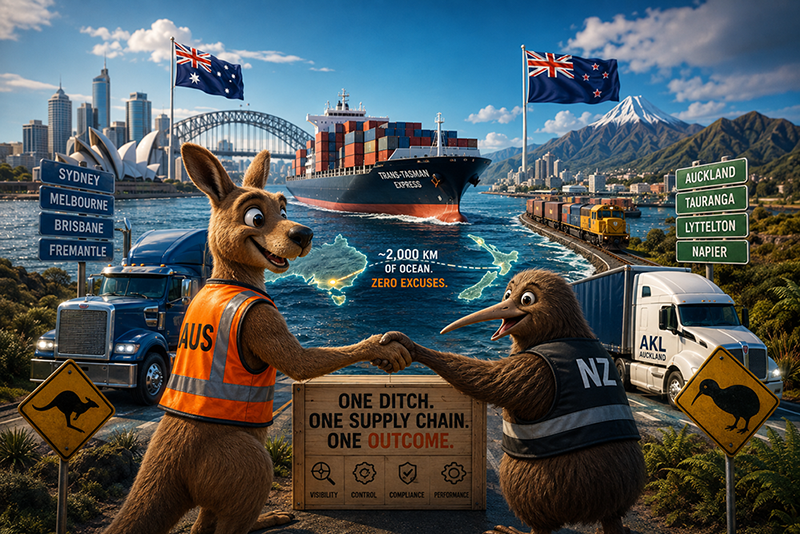
Trans-Tasman Landed Cost Calculator: What Shipping Between Australia & New Zealand Actually Costs
THE MOST DANGEROUS NUMBER IN YOUR SUPPLY CHAIN MIGHT BE THE ONE EVERYONE AGREES IS RIGHT.
A container costs $2,800 to move from Sydney to Auckland.
There it is. Nice clean number. Freight has been quoted. Procurement has approved it. Finance has dropped it into the model. Sales has priced the product. Everyone wanders off feeling strangely accomplished.
Except the container hasn't even started spending yet.
Because $2,800 was never the cost of getting that inventory into your business. It was the cost of one part of getting it there. Somewhere between the supplier and your warehouse, that beautifully behaved freight rate starts collecting friends. Terminal handling.
Documentation. Insurance. Government charges. Biosecurity. GST. Local delivery. Then, if the logistics gods are feeling particularly creative, detention, demurrage or an inspection joins the party.
The original $2,800 hasn't changed.
The truth around it has.
And this is where landed cost becomes far more interesting than another logistics calculation. Because when a business gets landed cost wrong, the mistake doesn't stay politely inside the freight department. It walks straight into pricing, margin, sourcing, inventory, cashflow and profitability.
A product can be selling brilliantly and still be making less money than everyone thinks.
That's the part nobody sees coming.

Trans-Tasman landed cost isn't a freight number. It's a margin number.
Ask most businesses what it costs to move a container across the Tasman and somebody can usually find the freight rate in about thirty seconds.
Ask what every unit inside that container actually owes the business when it reaches the warehouse, and suddenly the room gets quieter.
That's landed cost.
It is the true cost accumulated by inventory as it moves from the seller through the supply chain to the point where your business actually needs it. And for Trans-Tasman freight, that can mean considerably more than the ocean between Australia and New Zealand.
The original calculator brief identifies up to twelve cost components: the goods themselves, international freight, insurance, terminal handling, documentation and origin costs, customs clearance services, government import charges, biosecurity charges, customs duty where applicable, GST, local delivery and detention, demurrage or other exception costs.
Individually, most don't look particularly frightening.
That's exactly the problem.
Landed cost rarely arrives as one enormous surprise. It gets nibbled to death.
A few hundred dollars at origin. Another charge at destination. A government levy. An insurance premium. A delivery nobody included. Three days nobody planned for. Nothing dramatic enough to trigger a board meeting, but enough small bites and the margin you thought was sitting safely inside the product starts looking suspiciously thin.
We call this Landed Cost Creep.
And it is particularly dangerous because the business can be completely correct about every individual invoice and still be wrong about what the shipment cost.
The freight quote isn't lying to you. You're asking it the wrong question.
This is where businesses become obsessed with the wrong number.
Freight is wonderfully visible. It arrives on a quote. It can be benchmarked. Negotiated. Tendered. Compared. Someone can proudly announce they shaved $300 off a container and everyone gets to feel productive.
But saving $300 on freight while adding $450 somewhere else isn't a saving.
It's cost displacement with a victory lap.
That's why Transport Works doesn't look at freight cost in isolation. The commercially useful question isn't "Did we get a cheaper freight rate?"
It's "Did we get a better landed outcome?"
Those are not the same thing.
A more expensive freight option can sometimes create a lower landed cost if it reduces handling, storage, delays, inventory exposure or destination charges. A cheaper option can do exactly the opposite.
This is where traditional freight procurement gets itself into trouble. It optimises the part everyone can see while the rest of the supply chain quietly sends invoices from backstage.
We call it Rate Tunnel Vision.
And once you start looking for it, you see it everywhere.
Your spreadsheet can be mathematically perfect and commercially wrong.
This might be our favourite landed-cost trap.
The spreadsheet looks magnificent.
Formulas everywhere. Currency conversion working. Percentages calculated to two decimal places. Perhaps somebody has even frozen the top row.
It feels trustworthy.
But Excel can only calculate the costs somebody remembered to put into it.
Miss a destination charge and the formula doesn't complain. Use an old government levy and no red warning light appears. Forget local delivery and Excel doesn't lean across the desk and ask whether you were planning to leave the container at the port forever.
It simply calculates the wrong answer perfectly.
That's Spreadsheet Confidence.
The more precise the number looks, the less likely somebody is to question what went into it.
And this matters because some of the inputs have changed. New Zealand changed its goods-management levy structure from 1 April 2026, for example. The supplied brief correctly identifies that as a material change businesses using older landed-cost models need to account for.
The lesson is bigger than one levy.
A landed-cost model doesn't become wrong when the formula breaks. It becomes wrong when reality changes and the formula doesn't.
That is why the Transport Works Trans-Tasman landed cost calculator shouldn't simply calculate costs.
It should force businesses to question them.
When was this rate updated? Is it quoted or assumed? Does the Incoterm already include this charge? Is GST being treated as a product cost or cashflow requirement? Does the product actually qualify for CER treatment? Are destination charges included? What happens if biosecurity intervenes?
Suddenly we're not building another spreadsheet.
We're building a decision tool.
One shipment. A surprising number of hands in its pocket.
Start with the goods.
Already, there is a trap.
The supplier with the lowest unit price isn't necessarily the supplier with the lowest landed cost. Change the Incoterm and you change where responsibility and cost begin moving onto your side of the ledger. An EXW price and an FOB price aren't simply two different prices for the same product. They represent different pieces of the journey being included.
The cheapest product can become the most expensive inventory by the time it gets home.
Then international freight arrives. Sea, LCL, FCL, air, express. This is the number everyone watches, but rates move with capacity, fuel, carrier pricing, seasonality, equipment and market conditions. The indicative rates in the supplied calculator brief are useful for modelling examples, but they are exactly that: indicative rather than universal market prices.
Then insurance.
Then terminal handling.
Then documentation.
Then government charges.
Then biosecurity.
Then GST.
Then local delivery.
The journey starts looking less like one freight movement and more like a restaurant bill where twelve people ordered separately and somehow Finance is expected to work out who had the garlic bread.
And there is another problem.
Those costs don't necessarily arrive together.
Freight might live in one system. Customs-related charges somewhere else. Local transport somewhere else again. Tax sits with Finance. Detention appears later. Suddenly one physical shipment has produced five different financial versions of itself.
We call that Invoice Scatter.
Operations sees one container.
Accounts sees a small reunion.
Unless somebody deliberately pulls those costs back together, the business never really discovers what the inventory cost.
And if you don't know that, everything downstream is built on sand.
Zero duty does not mean zero border cost.
CER creates another beautiful little Trans-Tasman illusion.
Qualifying goods traded between Australia and New Zealand may receive preferential tariff treatment under the Australia-New Zealand Closer Economic Relations framework, subject to the applicable rules of origin.
So somebody sees $0 duty and mentally translates it into "the border doesn't cost us anything."
Absolutely not.
The duty line might be zero.
The shipment can still attract GST, government processing charges, biosecurity costs, terminal charges, documentation, clearance costs and everything else required to actually get the goods into the country and onwards to the warehouse.
CER can make one line disappear. It doesn't make the border disappear.
And qualifying origin matters. Buying something from an Australian company does not automatically make the product Australian-origin for preferential treatment purposes.
A Chinese-made product doesn't acquire an Akubra because it spent three months sitting in Brisbane.
That distinction belongs in the landed-cost model because duty assumptions affect the commercial answer.
GST creates two landed costs, and Finance needs to know both.
GST is where the conversation gets particularly interesting.
For a GST-registered business entitled to recover import GST, GST may not ultimately form part of the economic product cost in the same way as freight or terminal handling.
But that doesn't make it imaginary.
Recoverable cash is still cash before you recover it.
So a useful landed-cost calculator shouldn't give the business one heroic number at the bottom and call the job done. It should show two.
What does this shipment cost us economically?
And: How much cash do we need to land it?
Those numbers can be different.
That isn't an accounting nuisance. It's decision-support information.
A CFO looking at working capital needs one answer. A commercial team setting unit margin needs another. Operations planning the shipment needs to understand both.
When those teams work from different spreadsheets, landed cost becomes less of a calculation and more of an office rumour.
Biosecurity doesn't just add cost. It can wake up other costs.
Biosecurity deserves special treatment in a Trans-Tasman landed-cost model because its financial impact doesn't necessarily stop with the biosecurity charge itself.
An inspection can consume time.
Time can affect container availability.
That can affect delivery.
That can interact with storage, detention, demurrage or rescheduling.
And suddenly one event has started breeding other costs.
This is the bit a basic calculator misses.
It treats each cost as an independent row.
Real supply chains don't behave like independent rows. They behave like dominoes.
One event can change the economics of everything behind it.
This is why we separate the cost of the shipment you planned from the cost of the shipment you actually got.
We call them Base Landed Cost and Exception Landed Cost.
Base Landed Cost asks: What should this shipment cost if everything goes to plan?
Exception Landed Cost asks the considerably more useful question: What happens to that number when reality gets involved?
That second number matters enormously when comparing products, modes, suppliers and routes with different operational risk profiles.
Because cheapest-on-a-good-day and cheapest-over-a-year can be two completely different supply chains.
The most expensive landed-cost mistake isn't a missing charge.
It's what the business does with the wrong number afterwards.
This is where the conversation leaves logistics entirely.
Imagine a product costs $100.
Your model says it lands at $110.
So Sales prices it from $110. Finance forecasts margin from $110. Procurement compares suppliers from $110. Marketing builds promotions from $110.
Except it really lands at $116.
Six dollars.
Tiny.
Until you sell 100,000 units.
$6 × 100,000 = $600,000.
Nobody lost $600,000 in one dramatic logistics catastrophe.
Nobody crashed a ship.
Nobody misplaced a warehouse.
The business simply made thousands of perfectly sensible commercial decisions using the wrong starting number.
That's why landed cost is so dangerous when it's slightly wrong.
Big mistakes get investigated. Small mistakes get multiplied.
Landed cost isn't about calculating freight more accurately.
It's about preventing logistics assumptions from contaminating commercial decisions.
The Trans-Tasman landed cost calculator: stop guessing what the shipment owes you.
A landed-cost calculator should do one thing really well: show you the whole number before the invoices start arriving separately.
You enter the basics of the movement. Where it starts. Where it finishes. Sea or air. FCL or LCL. Shipment value. Weight or volume. Container type. Incoterm. Whether the goods qualify for CER treatment. Then the calculator pulls the cost apart properly.
Freight.
Insurance.
Terminal handling.
Documentation.
Government charges.
Biosecurity.
Duty where applicable.
GST.
Local delivery.
And the bits that have a nasty habit of being forgotten until somebody has already promised the margin to Sales.
Because the maths isn't the difficult part.
Remembering everything that belongs in the maths is.
A missing $300 charge doesn't look particularly terrifying on one shipment. Repeat it across 20 containers and you've misplaced $6,000. Spread missing costs across hundreds of SKUs and suddenly your margin report is telling a very convincing story about a business that doesn't actually exist.
One forgotten line item can look tiny. Across a container, a SKU range or a year of imports, tiny gets ambitious.
Frequently asked questions about Trans-Tasman landed cost
What is included in landed cost when shipping between Australia and New Zealand?
Trans-Tasman landed cost is the total cost of getting inventory from the seller to the point where your business actually needs it. Depending on the shipment, that can include the purchase price, international freight, insurance, terminal and documentation charges, customs-related costs, government levies, biosecurity charges, customs duty where applicable, GST, local delivery and exception costs such as storage, detention or demurrage.
The mistake is treating the freight quote as though it answers the same question.
It doesn't.
A freight quote tells you what a particular part of the movement costs. Landed cost tells you what the inventory owes you when the journey is finished.
And that number matters far beyond logistics. If landed cost is understated, product margin can be overstated. Pricing can be wrong. Supplier comparisons can be misleading. A product that looked beautifully profitable on the purchase order can arrive at the warehouse considerably less charming.
The freight rate moves the product. The landed cost moves the commercial decision.
How do you calculate landed cost from Australia to New Zealand?
Start with the cost of the goods, then add the costs required to get those goods to their final destination: international freight, insurance, origin and destination charges, applicable government levies, biosecurity costs, customs duty where applicable, GST treatment, local delivery and any other shipment-specific costs.
There isn't one universal percentage you can safely add to every shipment.
That is particularly important under the Australia-New Zealand Closer Economic Relations Trade Agreement (ANZCERTA). Goods that meet the applicable ANZCERTA Rules of Origin criteria can be traded across the Tasman free of customs duty, but zero duty does not mean zero landed cost.
Change the Incoterm, product, shipment value, mode, origin, destination or biosecurity requirements and the answer can change with it. ICC also confirms that Incoterms® allocate costs, risks and obligations between buyer and seller, which is why the agreed Incoterm matters to the calculation.
Landed cost isn't a percentage. It's a supply-chain fingerprint.
Two containers sailing on the same vessel can have completely different cost stories.
Does CER mean there is no import duty or customs cost between Australia and New Zealand?
Goods that satisfy the ANZCERTA Rules of Origin criteria can qualify for duty-free Trans-Tasman trade, but CER does not eliminate the other costs associated with importing goods. DFAT confirms that goods meeting ANZCERTA origin criteria can be traded across the Tasman free of duty and quantitative import restrictions.
That distinction is where businesses can get caught.
$0 duty is one empty box on the invoice. It isn't an empty invoice.
Depending on the shipment, there can still be GST, government processing or goods-management levies, biosecurity costs, freight, insurance, terminal handling, documentation, local delivery and other commercial charges.
And don't confuse where the shipment came from with where the goods originate for preferential tariff purposes. ANZCERTA has specific Rules of Origin. A product does not automatically become Australian-origin because it was shipped from Sydney, or New Zealand-origin because somebody put it on a vessel in Auckland.
CER can make one line disappear. It doesn't make the border disappear.
Is GST included in landed cost for imports into Australia?
GST should be considered in the landed-cost and cashflow calculation, but whether it ultimately represents an economic cost depends on the importing business and its GST treatment.
For taxable importations into Australia, Australian Border Force states that GST is generally 10% of the Value of the Taxable Importation (VoTI). VoTI includes the customs value of the goods, applicable customs duty, international transport and insurance to Australia, and Wine Equalisation Tax where applicable.
For eligible GST-registered importers, import GST may be recoverable as an input tax credit or, where the relevant requirements are met, payment may be deferred.
Which creates an important distinction.
Recoverable doesn't mean irrelevant.
Finance may need to know how much cash is required to land the shipment. Commercial teams need to know the net economic cost of the inventory. Those are different questions, and a useful landed-cost model should make the difference visible.
Because cashflow has a calendar, even when the tax eventually comes back.
Why is my actual landed cost higher than my freight quote?
Because your freight quote and your landed cost are measuring different things.
A freight quote may cover a defined transport service. Your actual landed cost can also include insurance, terminal charges, documentation, customs-related services, government import charges, biosecurity, duty, GST, local transport and costs created by delays or other exceptions.
Some of those costs are also moving targets. For example, Australian Border Force currently applies electronic Import Processing Charges of A$50 for consignments over A$1,000 and under A$10,000, and A$152 for consignments valued at A$10,000 or more. From 1 July 2026, the biosecurity Full Import Declaration charge is A$48 for air and A$71 for sea for consignments over A$1,000.
New Zealand also introduced a new goods-management levy structure from 1 April 2026. For high-value imports over NZ$1,000, the combined Customs and MPI levy is currently NZ$51.81 excluding GST for air and NZ$118.44 excluding GST for sea.
So when the final number comes in higher than the freight quote, it doesn't necessarily mean the freight quote was wrong.
It can mean the business stopped counting too early.
That's Landed Cost Creep: individually unremarkable costs accumulating around a shipment until the margin at the warehouse door looks rather different from the margin that left the spreadsheet.
And that is exactly why the question shouldn't be:
“What did we pay for freight?”
It should be:
“What did this inventory actually cost us to land?”
Stop asking what the freight costs.
There will always be another freight quote.
Another carrier.
Another rate.
Another spreadsheet.
Another $200 somebody thinks they can shave off the ocean leg.
Sometimes they can.
Fantastic.
Take it.
But don't confuse winning the freight rate with winning the supply chain.
The number that matters is what the inventory owes you when it is finally sitting where it needs to be, available to sell, without half its cost still hiding in somebody else's inbox.
Because your freight rate tells you what one part of the journey costs.
Your landed cost tells you whether the journey was worth making.
And when you're moving inventory between Australia and New Zealand, that isn't a logistics distinction.
It's the difference between the margin you put in the spreadsheet and the margin you actually get to keep.
GET THE REAL NUMBER.
The Brains Behind Tasman Freight
Local Chaos. Trans-Tasman Control.
INSIGHTS FROM DANYUL GLEESON, FOUNDER, CLUSTER-FREIGHT-FIXER & LOGISTICS CHAOS TAMER-IN-CHIEF AT TRANSPORT WORKS
Danyul has been in the trenches - warehouses where pick paths were sketched on pizza boxes and boardrooms where the “supply chain strategy” was a shrug. He built Transport Works to flip that script: a 4PL that turns broken systems into competitive advantage. His mission? Always Delivering - without the chaos.
Sources & References
Australian import costs and government charges
Australian Border Force (ABF) – Import Processing Charges
Used to support the Australian government charges included in the landed-cost calculation. For electronically lodged import declarations, ABF currently lists an Import Processing Charge of A$0 for consignments valued at A$1,000 or less, A$50 for consignments over A$1,000 and under A$10,000, and A$152 for consignments valued at A$10,000 or more.
Australian Border Force (ABF) – Biosecurity Cost Recovery Charges
Referenced for current Australian biosecurity charges collected by ABF on behalf of the Department of Agriculture, Fisheries and Forestry. From 1 July 2026, the Full Import Declaration biosecurity charge is A$48 for air freight and A$71 for sea freight for consignments over A$1,000.
Australian Border Force (ABF) – Cost of Importing Goods
Referenced for the broader Australian import-cost framework, including customs duties, taxes, exchange rates and available concessions that can affect the final landed cost of imported goods.
GST on Australian imports
Australian Border Force (ABF) – GST and Other Taxes When Importing
Used to support the Australian GST calculations discussed in the blog. GST on taxable importations is generally calculated at 10% of the Value of the Taxable Importation (VoTI). The VoTI incorporates customs value, applicable customs duty, international transport and insurance, and Wine Equalisation Tax where applicable.
Australian Border Force (ABF) – Value of Taxable Importation
Referenced for the underlying VoTI calculation used when determining GST payable on Australian taxable importations.
New Zealand Customs Service – Goods Levies and Hourly Rate
Used to support the new goods-management levy structure introduced on 1 April 2026. For high-value imports over NZ$1,000, the combined Customs and MPI levy is currently NZ$118.44 excluding GST for sea freight and NZ$51.81 excluding GST for air freight. For low-value imports of NZ$1,000 or less, the combined levies are NZ$2.09 for sea and NZ$2.21 for air, excluding GST.
New Zealand biosecurity costs
New Zealand Ministry for Primary Industries (MPI) – Fees and Charges for Importing
Used to support discussion of New Zealand biosecurity inspection and intervention costs. MPI operates on a user-pays cost-recovery basis and may charge importers for inspections, permits, testing, sampling, laboratory analysis, treatment, travel, storage, quarantine, destruction and other biosecurity services.
New Zealand Ministry for Primary Industries (MPI) – Biosecurity Inspection Charges
Referenced for the current normal-hours inspection rates. MPI currently lists NZ$155.50 per hour excluding GST for biosecurity and general inspectors, while veterinary inspection of live animals is listed at NZ$216.84 per hour excluding GST. Travel, waiting and after-hours charges may also apply.
New Zealand Ministry for Primary Industries (MPI) – Updated Fees and Charges
Referenced for the important point that regulatory fees and charges can change over time and therefore need to be reviewed when maintaining a landed-cost model. MPI notes that changes to many of its fees are usually effective from 1 July.
Incoterms and landed-cost responsibility
International Chamber of Commerce (ICC) – Incoterms® Rules
Used to support the article's discussion of how Incoterms affect the allocation of tasks, costs and risks between sellers and buyers. ICC describes the Incoterms rules as eleven three-letter trade terms used in contracts for the sale and purchase of goods.
International Chamber of Commerce (ICC) – Incoterms® 2020
Referenced for the current Incoterms® 2020 framework and its role in allocating cost, risk and obligations between buyers and sellers. This is particularly relevant when comparing supplier prices and determining which costs belong in a Trans-Tasman landed-cost calculation.
CER and Trans-Tasman preferential trade
Australian Government Department of Foreign Affairs and Trade (DFAT) – Australia-New Zealand Closer Economic Relations Trade Agreement (ANZCERTA)
Used to support the discussion of preferential trade between Australia and New Zealand and the distinction between a zero-duty outcome for qualifying goods and the broader costs of importing those goods.
Australian Government Department of Foreign Affairs and Trade (DFAT) – ANZCERTA Rules of Origin
Referenced for the article's explanation that preferential tariff treatment depends on goods meeting the applicable rules of origin, rather than simply being shipped from Australia or New Zealand.
Disclaimer:
The information in this blog is provided for general informational purposes only and is current as of the date of publication. Customs duties, charges, processes, policies, and rates are subject to change at any time without notice. We make no representations or warranties of any kind, express or implied, about the completeness, accuracy, reliability, suitability, or availability of the information contained in this article. You should not rely on this content as a substitute for official sources. For the most up-to-date and authoritative information, please consult the relevant government agencies, customs authorities, and reference websites directly. Ideas, interpretations, and opinions expressed here are subject to change as regulations, markets, and industry practices evolve. Transport Works and its authors accept no liability for any loss or damage whatsoever arising from reliance on the information in this blog.