
Global Shipping Regulations 2026: What Every NZ & AUS Importer Needs to Know (Before the Border Does It for You)
Updated: Jul 8
Your container lands.
The customer is waiting.
Finance is refreshing the spreadsheet like it owes them money.
Then Customs says no. Not seized. Not rejected. Just… stuck.
New levies. Extra biosecurity charges. A missing declaration that did not exist in your SOP last year.
Margin evaporates faster than a free sausage at Bunnings.
This is not bad luck.
This is 2026 doing what 2026 does best: changing the rules quietly and billing you loudly.
This guide exists so that does not happen to you.
Why 2026 Suddenly Got Expensive
Regulators did not wake up cranky. They woke up underfunded.
Across New Zealand and Australia, border agencies are leaning into risk-based, cost-recovery models. If your cargo creates work, it now creates a bill.
In New Zealand, the new goods management levy framework started 1 April 2026.
In Australia, audits around classification, origin, GST and concessions have become more data-driven and less forgiving.
This is live-fire compliance.
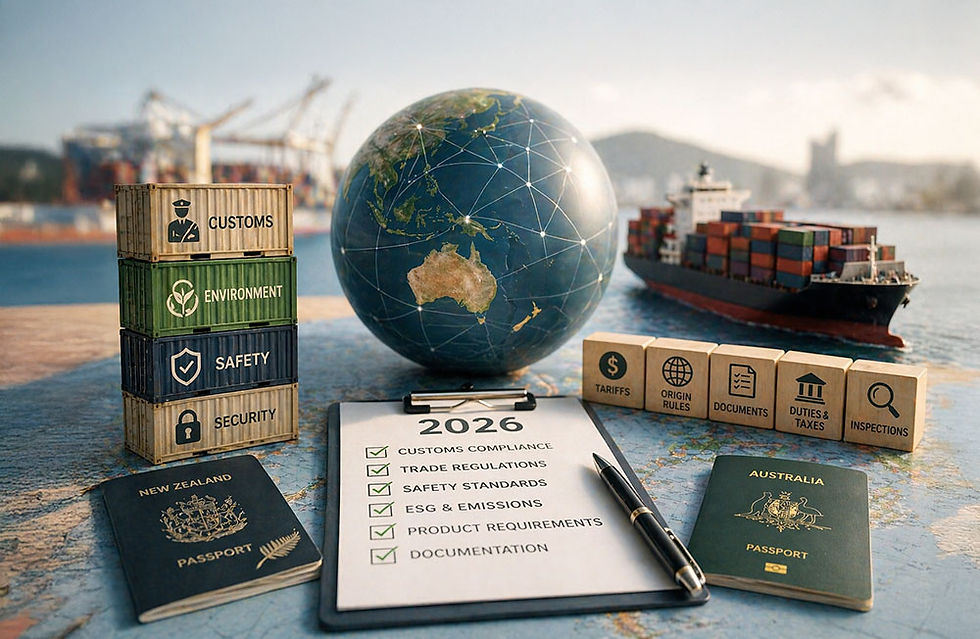
New Zealand 2026: Goods Levies, Biosecurity and Real Landed Cost
Goods Management Levies: The New Default
Key shifts you cannot ignore:
Low-value goods are now charged per consignment, not per cargo report.
Rates differ by air versus sea.
Charges now apply to empties, transhipments and commercial vessels.
This is not cosmetic.
It is a new pricing engine for the border.
New Zealand Goods Levy Rates 2026 - What the Numbers Actually Look Like
Headline Rates (Excl. GST)
Movement Type | Levy |
Low value import (air) | NZD 2.21 |
Low value import (sea) | NZD 2.09 |
High value import (air) | NZD 51.81 |
High value import (sea) | NZD 118.44 |
Air transhipment | NZD 1.46 |
Sea transhipment | NZD 1.34 |
Empty container | NZD 1.34 |
Commercial vessel levy | NZD 4,679.00 |
The information in this blog is provided for general informational purposes only and is current as of the date of publication. Customs duties, charges, processes, policies, and rates are subject to change at any time without notice. We make no representations or warranties of any kind, express or implied, about the completeness, accuracy, reliability, suitability, or availability of the information contained in this article. You should not rely on this content as a substitute for official sources.
What This Does to Real Import Costs
Impacts to model:
High-volume, low-value flows get squeezed.
Sea importers carry higher levy exposure.
Transhipments and empties stop being free edges.
Vessel levies flow into freight.
If you run ecommerce, subscription boxes, marketplace fulfilment or frequent replenishment, your landed cost assumptions may already be wrong.
Biosecurity: BMSB and Beyond
Biosecurity is not a side quest.
It is part of clearance strategy.
Importer realities:
Identify high-risk goods before booking.
Ensure approved treatment has occurred where required.
Make sure declarations match reality.
Non-compliance can trigger:
Onshore treatment costs
Delays
Re-export costs
Storage charges
Compliant traders move faster.
Everyone else pays in time and cash.
Customs Compliance NZ: The 2026/27 Documentation Checklist
Core commercial import documents:
Commercial invoice
Packing list
Bill of lading or air waybill
Relevant permits or licences
Importer/client codes
Common trip hazards:
Incorrect importer codes
Ownership details that do not align
Incorrect HS classification
Weak origin declarations
Assuming low value means low scrutiny. It does not.
Australia 2026: Import, GST and Concessions That Still Bite
Australia has not had the dramatic fee reset NZ has.
But enforcement has tightened.
Import Documentation and Clearance
For many commercial shipments at or above AUD 1,000, importers must:
Lodge a formal import declaration
Pay duty, GST and applicable taxes
Provide origin evidence where claiming FTA benefits
Core document set:
Commercial invoice
Packing list
Bill of lading or AWB
Import permits where required
FTA or origin documentation
Import Tax, GST and Concessions in 2026
Key points:
Duty may average around 5% on many goods, but varies.
GST is generally 10%.
FTAs and TCOs can reduce duty, but only when conditions are met.
What trips importers up:
Misclassification
Weak origin claims
Lazy use of concessions
ABF audits can run backwards.
Errors echo.
Export Controls and Strategic Goods
If you move dual-use or strategic goods:
Expect tighter controls.
Expect more scrutiny.
Do not guess.
NZ vs Australia: 2026 Import Rules at a Glance
New Zealand
New goods levies
Strong MPI biosecurity controls
NZ Customs + MPI oversight
Australia
Stable duty/GST framework with tighter enforcement
ABF + DAFF oversight
Greater audit scrutiny
Aspect | New Zealand (May 2026) | Australia (May 2026) |
Clearance threshold | All commercial goods must be cleared by NZ Customs; import declaration typically required above NZD 1,000. | Formal import declaration typically required from AUD 1,000 customs value. |
Key cost changes | New goods levies from 1 Apr 2026, mode-specific rates, per-consignment charging, levies on transhipments, empties and vessels. | Duty/GST framework stable but enforced more tightly, focus on HS, origin, GST and concessions. |
Biosecurity | Strong MPI controls, risk-based screening, BMSB and seasonal risks; funded via levies and charges. | Biosecurity managed via ABF and DAFF with risk-based inspections and seasonal measures. |
Core documents | Invoice, packing list, BL/AWB, permits/licences, importer/client IDs, facility/biosecurity evidence. | Invoice, packing list, BL/AWB, import declaration, origin documents, permits where required. |
Regulators | New Zealand Customs Service and Ministry for Primary Industries (MPI) | Australian Border Force (ABF) and Department of Agriculture, Fisheries and Forestry (DAFF) |
2026 Freight Regulation Trends You Cannot Ignore
Cost Recovery Is the Default
More regulatory costs are flowing back into trade.
Documentation Is the New Risk Profile
Messy paperwork has become a billable risk signal.
Biosecurity Is Non-Negotiable
Not an edge case. A structural reality.
The 2026/27 Importer Playbook (Use This)
1. Audit Your Landed Cost Model
Build in:
NZ levies
Duty assumptions
GST assumptions
FTA and TCO validation
If levies are not visible in your costing file, you are guessing margin.
2. Standardise Your Customs Data
Control:
HS codes
Product descriptions
Country of origin
Invoice consistency
Predictability clears freight.
3. Clarify Responsibility Across Partners
Define who owns:
Declarations
Regulatory monitoring
Customs responses
SOP updates
When no one owns it, you pay for it.
4. Prepare for Biosecurity Seasons
Build seasonal controls into:
Booking flows
Lead times
Cost budgets
Treat them like weather.
Plan for them.
5. Watch Official Channels, Not LinkedIn Panic
Monitor:
New Zealand
NZ Customs
MPI
Australia
ABF
DAFF
Official sources age better than rumours.
Want to stay ahead of global trade changes instead of reacting at the border? Read:
THE BRAINS BEHIND BETTER VISIBILITY.
LOCAL CHAOS. GLOBAL CONTROL.
Global Shipping Regulations 2026: What Every NZ & AUS Importer Needs to Know FAQs
What are the biggest shipping and customs changes for NZ importers in 2026?
From 1 April 2026, New Zealand replaces existing goods fees with goods management levies, fundamentally changing how border costs are charged. Levies now differ by air and sea, apply per consignment for low-value goods (NZD 1000 or less), and extend to international transhipments, empty containers, and commercial vessels. This means landed costs increase for high-volume importers, particularly ecommerce and low-value B2B flows, even if shipment sizes stay the same.
How will the 2026 NZ goods management levies affect landed costs?
The 2026 levies shift more border management costs directly onto importers instead of taxpayers. Businesses importing many small consignments will see higher per-unit costs due to per-consignment charging, while freight rates may rise as vessel and container levies flow through carrier pricing. Importers that do not update their landed cost models risk margin erosion, pricing errors, or unprofitable SKUs without realising why.
What does “customs compliance” mean in New Zealand in 2026?
Customs compliance in New Zealand means accurately declaring shipment value, tariff classification, origin, permits, and biosecurity requirements, while paying the correct duties, GST, and levies under the 2026 framework. Agencies like New Zealand Customs Service and MPI increasingly rely on risk profiling, data matching, and audits, meaning inconsistent or incorrect documentation can trigger inspections, delays, and retrospective charges.
What import documentation is required for Australia in 2026?
Most commercial imports into Australia require a commercial invoice, packing list, and transport document, with a formal import declaration typically required for goods valued at AUD 1000 or more. Importers must also pay customs duty, GST, and any applicable taxes, and provide origin documentation to claim Free Trade Agreement benefits. Australian Border Force places strong emphasis on correct classification and origin, with errors often resulting in back-duties or penalties.
How can NZ and Australian importers reduce compliance risk in 2026?
The most effective way to reduce compliance risk in 2026 is to standardise customs data across all shipments, audit HS codes and origin claims, and proactively build new NZ levies and Australian tax rules into landed cost calculations. Importers that work closely with logistics and customs specialists, run quarterly compliance reviews, and plan ahead for biosecurity seasons experience fewer holds, faster clearance, and more predictable costs as regulations tighten.
Where Transport Works Makes Compliance Pay
Good logistics partners move freight.Great ones translate regulation into money saved and delays avoided.
We help importers:
Turn regulatory updates into clear landed cost models.
Coordinate brokers, carriers and documentation so cargo clears first time.
Stay ahead of levies, audits and seasonal biosecurity traps.
If you want your 2026 import profile reviewed before the rules review you, we should talk.
Transport Works. Because Your Supply Chain Won’t Fix Itself.
Insights from Danyul Gleeson, Founder & Logistics Chaos Tamer-in-Chief at Transport Works
Danyul has been in the trenches - warehouses where pick paths were sketched on pizza boxes and boardrooms where the “supply chain strategy” was a shrug. He built Transport Works to flip that script: a 4PL that turns broken systems into competitive advantage. His mission? Always Delivering - without the chaos.
Disclaimer:
The information in this blog is provided for general informational purposes only and is current as of the date of publication. Customs duties, charges, processes, policies, and rates are subject to change at any time without notice. We make no representations or warranties of any kind, express or implied, about the completeness, accuracy, reliability, suitability, or availability of the information contained in this article. You should not rely on this content as a substitute for official sources. For the most up-to-date and authoritative information, please consult the relevant government agencies, customs authorities, and reference websites directly. Ideas, interpretations, and opinions expressed here are subject to change as regulations, markets, and industry practices evolve. Transport Works and its authors accept no liability for any loss or damage whatsoever arising from reliance on the information in this blog.
Sources & References
Official New Zealand Sources
New Zealand Customs Service Goods management levies, customs clearance requirements, importer obligations, and official notices relating to border cost recovery reforms effective from 1 April 2026.Source: NZ Customs official policy updates and fee schedules.
Ministry for Primary Industries Biosecurity controls, import health standards, and Brown Marmorated Stink Bug (BMSB) seasonal requirements, including treatment and declaration obligations for US–NZ and other high-risk lanes.Source: MPI Biosecurity New Zealand guidance and seasonal risk documentation.
New Zealand Government – Cabinet & Regulatory Impact Statements Background on the approval and rationale for shifting from goods fees to goods management levies, including cost recovery and risk-based charging models.Source: NZ Government regulatory and Cabinet papers.
Official Australian Sources
Australian Border Force Import clearance rules, formal import declaration thresholds (AUD 1000), documentation requirements, customs duties, GST treatment, audits, and compliance guidance.Source: ABF “Importing goods” and customs compliance publications.
Department of Agriculture, Fisheries and Forestry Biosecurity import requirements, permits, inspections, and risk-based controls for goods entering Australia.Source: DAFF biosecurity import conditions and permit frameworks.
Australian Government – Tariff Concession Orders and Free Trade Agreements Guidance on duty reduction mechanisms, eligibility rules, origin documentation requirements, and compliance risks associated with incorrect claims.Source: Australian Government customs and trade portals.
Export Control and Strategic Trade References
Australian Government – Defence Trade Controls Framework Overview of export controls for defence and dual-use goods, including tightened rules post-2024 and AUKUS-related licensing frameworks.Source: Australian Government Defence Trade Controls publications.
International and Trade Context Sources
World Customs Organization (WCO) Global best practices on customs risk management, self-assessment models, and data-driven compliance trends influencing NZ and Australian border reforms.Source: WCO policy papers and guidance.
OECD – Trade Facilitation and Border Management Analysis of cost recovery, trader risk profiling, and digital customs enforcement trends adopted by advanced economies.Source: OECD trade and customs policy research.
Practical Industry Context
Port Authorities and Carrier Advisories (NZ & AUS) Operational notices on vessel charges, container handling, and flow-through costs linked to regulatory and levy changes.Source: Port of Auckland, Port of Melbourne, and major carrier advisories.


This is a highly insightful breakdown of the upcoming changes in New Zealand’s goods levy structure, and it clearly highlights how these adjustments will reshape real landed cost calculations for importers. The shift toward per-consignment charges and the inclusion of transhipments and empty containers will definitely put pressure on high-volume, low-value shipments. For businesses relying on flexible shipping models like less than truckload, these changes make it even more important to revisit pricing strategies, optimize shipment consolidation, and ensure accurate cost forecasting to stay competitive in a rapidly evolving logistics environment.