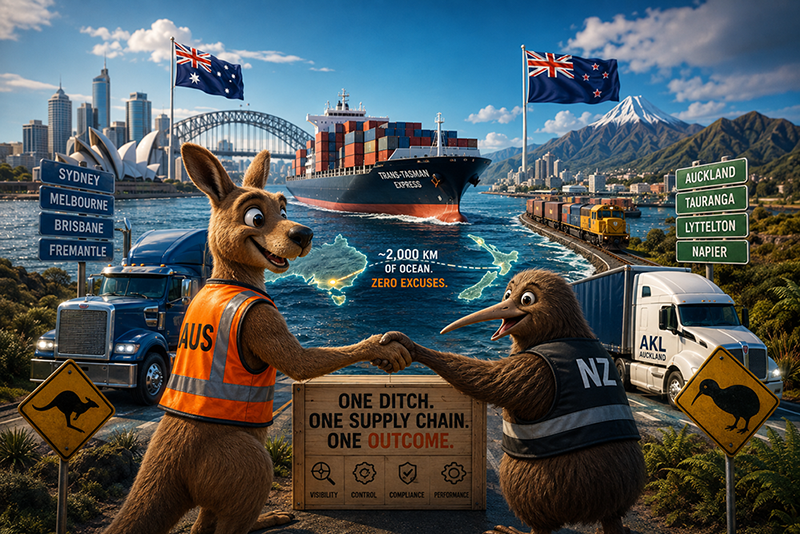
How to Choose a Trans-Tasman Freight Partner: The 12 Questions to Ask Before the Cheap Quote Starts Eating Your Margin
Updated: Sep 3
Every Supply Chain provider looks brilliant when the freight behaves.
So does a fire brigade when nothing is on fire.
Every Trans-Tasman freight provider looks brilliant when the freight behaves.
So does a fire brigade when nothing is on fire.
The trucks are polished. Everyone knows where the hoses are. Somebody has probably produced a reassuring diagram showing exactly what happens in an emergency.
Lovely.
But you don’t choose a fire brigade for the sunny Tuesday when absolutely bugger-all happens.
You choose them for 2:13am when there is smoke under the door and you need to know who can tell the difference between looking extremely busy and actually stopping the building from burning down.
Freight partners should probably be selected the same way.
Instead, most businesses tender the predictable version of logistics. Melbourne to Auckland. Sydney to Christchurch. FCL. LCL. Air. Sea. Volumes annualised into obedient columns while providers compete to shave a few dollars from a fictional world where vessels sail, documents behave, Customs remains pleasantly uninterested and nobody from Sales has promised the customer something heroic.
In other words, we choose logistics providers by testing them on the bit of logistics that barely needs a provider.
Then the first proper freightmare arrives and everyone discovers what they actually bought.
A rolled vessel becomes a stock problem. The stock problem becomes a warehouse problem. The warehouse problem becomes a customer problem. And somewhere around email number 26, what started as “a slight delay” has wandered into Operations, Finance, Sales and Customer Service and started eating biscuits in the boardroom.
The freight did not simply arrive late.
The problem travelled further than the container.
That is the bit your tender needs to test.
TL;DR
Every Trans-Tasman freight provider looks impressive when the freight behaves.
The useful question is what happens when it doesn’t.
The cheapest quote can become remarkably expensive once Customs, biosecurity, missed sailings, storage, poor visibility and the ancient logistics tradition of “that’s not our bit” join the shipment.
So don’t choose a freight partner by asking who can move a container from Australia to New Zealand.
Choose them by finding out who still owns the problem when the container develops a personality.

How to Choose a Trans-Tasman Freight Partner When Everyone Looks Good in the Tender
Australia and New Zealand should be easy.
That sentence has probably funded several storage invoices.
The two countries have one of the world’s closest trading relationships. Under ANZCERTA, qualifying goods have traded across the Tasman free from tariffs and quantitative import restrictions since 1990, according to Australia’s Department of Foreign Affairs and Trade.
Commercially close. Geographically close.
Operationally, your container can still find enough ways to ruin Thursday to suggest it has hobbies.
Because the Tasman Sea is rarely the difficult part. The trouble lives around it. Documentation. Biosecurity. Customs. Carrier schedules. Warehouse cut-offs. Delivery windows. Data. Subcontractors. Charges. And that tiny patch of daylight between where one provider’s responsibility ends and another begins.
That gap is where “not our area” lives.
So if you are working out how to choose a Trans-Tasman freight partner, stop asking only who can move the freight.
Of course they can move it.
Ask where the mess goes when the plan stops working.
If the answer is back into your business, keep reading.
1. How Much Trans-Tasman Freight Do You Actually Live and Breathe?
There is a difference between having something on the menu and being good at cooking it.
The restaurant serving sushi, carbonara and butter chicken across six laminated pages may technically be capable of all three. You are still ordering with a certain amount of spiritual courage.
Freight is no different.
Almost every international provider can tell you they “do New Zealand”. The useful question is whether the lane is part of their operating muscle memory or simply another pair of ports in the booking system.
Ask what repeatedly goes wrong. Ask which ports, commodities and customers dominate their experience. Ask what has changed over the past year. Ask what they now do differently because of something that hurt previously.
That last question matters.
Experience is not doing something repeatedly. Experience is what happens when repetition improves judgement.
A genuine Trans-Tasman specialist has seen enough versions of the same problem to recognise it while it is still wearing a fake moustache.
A generalist waits until it introduces itself.
2. Can They Explain the Border Without Breaking Into Acronym Karaoke?
ATT. SES. AEO. MRA.
Nothing makes logistics sound more sophisticated than four acronyms arriving in convoy.
Unfortunately, border competence is not Scrabble.
Australian Trusted Trader is Australia’s Authorised Economic Operator programme. New Zealand’s Secure Exports Scheme operates differently and is focused on secure export supply chains. They are not interchangeable badges that every freight company should simply wave around during a tender.
Why does that matter?
Because regulatory sloppiness rarely stays theoretical.
A provider that confidently rounds off the small distinctions is eventually going to round off one attached to your shipment.
And the border is a poor place to discover somebody’s understanding was mostly PowerPoint-deep.
You are not testing whether they can recite the acronyms. You are testing whether they understand what applies to your freight, what does not, and where the commercial consequences sit.
The more complicated the terminology sounds, the less impressed you should be by vague answers.
3. Who Actually Handles Customs When Customs Stops Being Routine?
“We handle Customs.”
Four innocent words.
They can conceal an entire family tree.
In Australia, import declarations can be lodged by the goods owner or by a licensed customs broker acting on their behalf. Most regular importers use brokers because getting it wrong is considerably less entertaining than getting it right.
So ask who actually performs the work.
Not which logo appears on the proposal.
Who deals with classification questions?
Who speaks to Customs when something needs clarification?
Who understands your products?
Who has authority to make a call when the answer is not sitting neatly inside a tariff database?
This is where supposedly outsourced logistics can turn into organisational ping-pong. Broker asks forwarder. Forwarder asks customer. Customer asks supplier. Supplier sends something unhelpful. Two days later everyone is technically waiting on everyone else.
The issue is not whether a third party is involved.
The issue is how far the problem has to travel before it reaches somebody capable of solving it.
Because “just waiting on clarification” sounds harmless right up until the container starts charging rent.
4. Show Me Your Technology on Its Worst Day
Never let a logistics provider demo a healthy shipment.
Healthy shipments make every platform look like NASA.
Little vessel icon. Green milestone. ETA behaving. Everybody enormously pleased with modern technology.
Now show me the ugly one.
The ETA has moved. The connection is missed. Customs wants something. The Auckland warehouse slot is hanging on by a fingernail.
What does the system do?
Does it tell you the shipment is late, or does it tell you what being late is about to break?
There is a very big difference.
A red dot on a screen is not control. It is a Fitbit on a heart attack. Technically, you have information. The patient remains inconveniently unwell.
That is Visibility Theatre: plenty to look at, very little to act on.
Useful visibility shortens the distance between warning and decision. It shows what changed, what is now exposed and who needs to move before somebody else discovers the problem from a customer complaint.
If the dashboard only gets interesting after the failure, you have bought an expensive rear-view mirror.
5. Show Me the Quote. Now Show Me What Someone Actually Paid.
Cheap freight has remarkable breeding capabilities.
It starts life looking lean and well behaved.
Then origin charges appear. Destination handling turns up. Storage has opinions. Detention arrives late but still expects to be paid. Biosecurity gets involved. Somewhere near the bottom of the invoice is an “adjustment” nobody remembers discussing.
Suddenly the freight rate that won the tender is no longer the number anybody is actually paying.
Not every additional charge is illegitimate. Freight changes. Things happen.
The better question is whether the provider can explain the journey from quote to invoice without requiring forensic accounting and three forwarded emails from April.
Ask to see an anonymised quote beside the final invoice from the same real shipment.
What moved?
Why?
Which charges were predictable?
Which were preventable?
When did the customer know?
The cheapest quote may be completely accurate.
It may also be telling the smallest possible version of the truth.
And that is why freight procurement can save money while the supply chain somehow becomes more expensive.
6. What Does Their “Average” Hide?
Averages are family Christmas photos.
Everyone is smiling.
Nobody can see the argument that happened five minutes earlier.
A provider tells you its average clearance time is four days.
Great.
Now ask what sits underneath the average.
How many cleared in two?
How many took seven?
What happened to the ugly ones?
Were delays caused by border intervention, missing paperwork, poor preparation, customer behaviour or the provider itself?
Because consistency matters more than a flattering mean.
A business can plan around four days.
It struggles to plan around “usually somewhere between two and nine, depending on what sort of week the universe is having”.
The best logistics operations do not obsess only over making good shipments slightly better.
They attack the long tail.
Reliability comes from reducing the number of shipments that unexpectedly grow fangs.
That is the data worth seeing.
7. What Do They Do About New Zealand Biosecurity Before MPI Has To?
New Zealand biosecurity has ruined enough optimistic assumptions to deserve its own chair at the logistics meeting.
The wrong question is: “How quickly can you deal with an MPI issue?”
The better one is: “What are you doing before departure to stop avoidable problems reaching MPI in the first place?”
MPI requires relevant arriving goods and containers to move through approved transitional facilities, with inspection or treatment required where biosecurity risk demands it.
But the expensive bit often starts much earlier.
Container cleanliness. Packaging. Treatment. Commodity information. Documentation. Supplier behaviour. Facility selection.
A provider can become extremely impressive at solving emergencies it helped create upstream.
That is still competence.
It is just the expensive variety.
An excellent root-canal specialist is wonderful to have.
You would still rather someone noticed the cavity six months earlier.
The grown-up version of biosecurity management is not heroically fixing every hold.
It is preventing the avoidable ones from becoming stories at all.
8. What Happens When Your Freight Stops Being Convenient?
Standard freight behaves beautifully during tender presentations.
Then Marketing launches something with lithium batteries.
Sales wins a customer with temperature requirements.
Engineering needs an oversized item moved yesterday.
And the general international team suddenly develops the expression of a Labrador being shown a tax return.
This is where “yes, we handle that” needs interrogation.
Who handles it?
What actually sits in-house?
Where does capability stop?
What gets subcontracted?
What information is needed before a reliable quote can even exist?
Because today’s unusual freight has a habit of becoming next year’s volume.
The question is not whether the provider can move every imaginable commodity.
Nobody sensible needs that.
The question is whether their capability can stretch as your business changes without turning every new requirement into a fresh procurement exercise.
Growth has an irritating habit of exposing the limitations you happily ignored when everything was smaller.
9. What Happens When Something Expensive Gets Bent, Broken or Wet?
Insurance is the part of a logistics contract everybody becomes intensely interested in approximately nine seconds after something valuable hits the floor.
Before that?
Scroll. Scroll. Sign.
Ask what is actually covered.
Ask where carrier liability ends.
Ask who manages the claim.
Ask what evidence will be needed.
Ask what happens when several parties each develop a compelling theory explaining why the damage belongs to somebody else.
The issue is not expecting catastrophe.
The issue is recognising that risk does not disappear because nobody priced it properly.
A supply chain can look wonderfully efficient right up until a high-value shipment is damaged and everyone discovers the commercial model was underwritten by optimism.
Insurance tells you where the financial pain lands when physical control fails.
That is worth understanding before the forklift creates modern art.
10. Would You Trust Them With More Than the Freight?
Nobody particularly enjoys asking a prospective provider about financial stability.
It feels awkward.
So does explaining why customer inventory is now sitting inside the collapse of a supplier nobody bothered checking.
A freight provider may temporarily sit between your business and its stock, cash, customers, data and ability to trade.
That deserves more due diligence than a nice website and a reference who suspiciously loves absolutely everything.
Ask how long they have operated.
Talk to customers with genuinely comparable supply chains.
Ask how long those relationships have lasted.
Understand what happens if a major subcontractor fails.
The bigger the piece of your operation being handed across, the more serious the due diligence should become.
Price tells you what the provider costs. It does not tell you how expensive they could become if they disappear.
11. Who Actually Remembers How Your Business Works?
Dedicated account manager.
Lovely.
Dedicated to you?
The lane?
Thirteen other customers and whatever arrives before lunch?
One of the quiet costs of provider churn is institutional amnesia.
The account manager leaves. The replacement arrives cheerful and well briefed. Then you spend three months rediscovering all the little things the previous person knew.
Auckland cannot receive that customer after 2pm. This SKU needs extra attention. That carrier ETA becomes unreliable after a failed scan. This supplier needs chasing before documentation cut-off, not after.
None of it sounds strategic.
Until nobody remembers it.
A strong logistics relationship should accumulate knowledge, not reset every time LinkedIn announces somebody’s exciting new opportunity.
If the operation only works because one heroic person knows where all the bodies are buried, that is not account management.
That is key-person risk with a mobile number.
12. Tell Me About the Last Time Everything Went Completely Sideways
This is the question the glossy case study was designed to prevent you asking.
Ask anyway.
Tell me about the rolled booking. The biosecurity hold. The missing documents. The customer escalation. The container accruing charges while everyone discovered the limits of their own job description.
Who noticed first?
Who told the customer?
Who made the decision?
What did it cost?
And most importantly, what changed afterwards?
Because mistakes happen.
The interesting part is whether the organisation metabolises them.
Anyone can look competent beside a healthy shipment.
The provider worth trusting is the one that can show how failure sharpened the system rather than simply becoming another incident number in the monthly review.
Exceptions are not interruptions to logistics.
They are logistics revealing what the operating model was made of.
The 36-Point Scorecard, Without Letting the Spreadsheet Develop Opinions
Give each provider zero to three against each question. Zero means fog. One means a claim. Two means a demonstrated process. Three means evidence, ownership and proof that something useful happens when the process fails.
Thirty-six points are available, but do not let the total become a tiny dictator with conditional formatting.
A provider losing points because its portal looks like Windows XP presents a very different risk from one losing points because nobody can explain who owns a Customs escalation.
The score helps structure the conversation.
Judgement still has to turn up for work.
Freight Forwarder vs 3PL vs 4PL: How Much Complexity Do You Want Back?
The wrong question is whether a freight forwarder, 3PL or 4PL is “best”.
Best at what?
If your problem is moving international freight and you already have the capability to manage everything around it, a strong forwarder may be exactly right.
If the work sits in warehousing, fulfilment and distribution, a 3PL may remove the right operational burden.
But if your team spends its week connecting forwarders, brokers, warehouses, carriers, systems, invoices and customer promises, something different has happened.
You outsourced the execution.
You kept the orchestration.
This is where outsourced logistics develops its own strange internal department.
Someone checks the ETA. Someone warns the warehouse. Someone updates Customer Service. Someone reconciles the invoice. Someone knows which provider needs chasing twice.
Eventually one capable person becomes the thing joining the entire network together.
That is Human Middleware.
Sarah knows the spreadsheet. Sarah knows who answers the phone. Sarah knows which ETA not to trust. Sarah knows why SKU 4267 becomes troublesome in New Zealand.
Sarah is also going to Fiji next Thursday.
And suddenly everyone discovers the sophisticated Trans-Tasman logistics model has an undocumented API called Sarah.
That is not resilience.
That is annual leave with consequences.
The cost of those internal hours belongs in your freight decision even if nobody has ever given them a freight code.
Some providers are cheaper because they are genuinely cheaper.
Others are cheaper because part of their operating model quietly happens inside your building.
Know which one you are buying.
One Last Question: Are They Paying Attention?
Ask a prospective Trans-Tasman partner what has changed this year.
Then listen.
New Zealand Customs and MPI changed their goods-levy structure from 1 April 2026, affecting how different consignments and goods movements are charged.
Does one levy change your entire supply chain?
Of course not.
Should somebody selling themselves as a Trans-Tasman specialist know about it without disappearing for forty minutes to ask Accounts?
Absolutely.
Because expertise goes stale quietly.
Old assumptions remain in rate models. Old rules survive inside SOPs. Everyone keeps doing what worked last year until reality sends an invoice explaining that last year has ended.
A provider does not need to predict the future.
But they should at least have noticed the present.
The Best Sign May Be the One That Costs Them Money
There is one answer worth listening for in any logistics review:
“Don’t buy that.”
Keep the warehouse.
That carrier is actually performing.
Your freight rate is fair.
You do not need a 4PL yet.
The technology is not the problem.
Your process is.
Be suspicious of a provider whose diagnosis always ends with buying more of that provider.
If every problem mysteriously leads back to their warehouse, fleet, platform or service offering, you may not be receiving strategy.
You may be receiving capacity utilisation with excellent presentation skills.
The strongest logistics partners are occasionally commercially inconvenient to themselves.
Because sometimes the best recommendation is the one they cannot invoice.
Frequently asked questions: How to choose a Trans-Tasman Freight Partner
What should I look for when choosing a Trans-Tasman freight partner?
Look past the rate card. The things that become expensive later are usually harder to put into Excel: who owns exceptions, how quickly decisions get made, whether Customs and biosecurity capability is real or subcontracted into the fog, how well the provider understands the Australia-New Zealand lane, and how much coordination your own team will still be left doing.
The best Trans-Tasman freight partner is not necessarily the provider that moves the container cheapest. It is the one that stops a freight problem becoming an inventory problem, then a warehouse problem, then a customer problem, then a margin problem.
If they only look good when the freight behaves, you haven’t tested the interesting bit yet.
What is the difference between a freight forwarder, 3PL and 4PL for Trans-Tasman freight?
The useful difference is not the acronym. It is how much complexity comes back to you.
A freight forwarder primarily arranges the international movement. A 3PL typically takes on more logistics execution, such as warehousing, fulfilment and distribution. A 4PL sits across the wider network, coordinating multiple logistics providers, data, performance and exceptions.
If your forwarder, Australian warehouse, New Zealand 3PL and domestic carriers all work perfectly well individually but your people spend half the week joining them together, the problem is no longer execution.
You outsourced the logistics. You kept the orchestration.
How can I tell if a Trans-Tasman freight quote is actually competitive?
Do not compare the opening number. Compare what survives the journey to the final invoice.
A genuinely useful Trans-Tasman freight quote should make it clear what is included, what is variable, which third-party charges may be passed through and what events can trigger additional cost. Then ask the provider to show you an anonymised quote beside the final invoice from the same real shipment.
Because the cheapest quote can be completely accurate and still become the most expensive option once storage, detention, biosecurity, destination charges, internal labour and exception management start breeding around it.
A freight rate tells you what it costs to move the freight. It does not necessarily tell you what the freight will cost the business.
Is Trans-Tasman freight duty-free between Australia and New Zealand?
Not automatically.
Under ANZCERTA, goods that satisfy the applicable Rules of Origin can be traded between Australia and New Zealand free of customs duty and quantitative import restrictions. That does not mean the shipment is border-free, paperwork-free or cost-free. Customs requirements, GST, biosecurity controls, freight charges and other border or handling costs can still apply.
That distinction matters because “duty-free” has an unfortunate habit of being interpreted as “nothing complicated happens at the border”.
The border did not receive that memo.
Why is New Zealand biosecurity such an important part of Trans-Tasman freight?
Because New Zealand treats biosecurity risk seriously, and by the time a problem is sitting at the border, many of your cheapest options have already disappeared.
MPI requires biosecurity-risk goods to meet relevant import health standards, and sea containers arriving in New Zealand must move through approved transitional-facility arrangements. Goods may require inspection or treatment before clearance.
The better question for a Trans-Tasman freight partner is therefore not simply, “How quickly can you fix an MPI problem?”
It is:
“What are you doing before departure so avoidable problems never reach MPI in the first place?”
Firefighting gets better stories. Prevention usually gets the better P&L.
So, How Do You Choose a Trans-Tasman Freight Partner?
Choose them for the freightmare.
The rolled vessel. The MPI query. The missing document. The warehouse slot that disappears. The customer already promised Monday.
That is when the brochure catches fire.
Nobody cares who saved $140 on the quote when Operations is rebuilding the week and Finance is wondering why one container has developed its own cost centre.
They care about one thing.
Who is fixing this?
Because the Tasman rarely eats the margin by itself.
The gaps do.
And when four providers are all technically doing their jobs while your supply chain is still falling over, you need somebody capable of seeing more than their own little square of it.
So forget asking whether they can move freight between Australia and New Zealand.
That bar is lying on the floor.
Ask whether, when everything starts going sideways, they step in.
Or step sideways.
Transport Works. Because Your Supply Chain Won’t Fix Itself.
Want to know what else can happen while your freight is crossing the ditch? Read:
The Brains Behind Tasman Freight
Local Chaos. Trans-Tasman Control.
INSIGHTS FROM DANYUL GLEESON, FOUNDER, CLUSTER-FREIGHT-FIXER & LOGISTICS CHAOS TAMER-IN-CHIEF AT TRANSPORT WORKS
Danyul has been in the trenches - warehouses where pick paths were sketched on pizza boxes and boardrooms where the “supply chain strategy” was a shrug. He built Transport Works to flip that script: a 4PL that turns broken systems into competitive advantage. His mission? Always Delivering - without the chaos.
Sources & References
Trans-Tasman trade and ANZCERTA
Australian Government Department of Foreign Affairs and Trade (DFAT) – Australia-New Zealand Closer Economic Relations Trade Agreement (ANZCERTA)
Used to support the Trans-Tasman trade framework referenced throughout this article. DFAT confirms that ANZCERTA covers substantially all trade in goods and services between Australia and New Zealand and that, since 1 July 1990, goods meeting the applicable ANZCERTA Rules of Origin have been free of duty and quantitative import restrictions.
This is an important distinction throughout the article: tariff-free Trans-Tasman trade does not mean border-free, paperwork-free, biosecurity-free or consequence-free logistics.
Australian Customs, Trusted Trader and border capability
Australian Border Force (ABF) – Australian Trusted Trader
Referenced for Australia's Authorised Economic Operator framework. Australian Trusted Trader accredits eligible Australian importers, exporters and service providers that demonstrate secure international supply chains and high levels of trade compliance.
ABF states that accredited Trusted Traders can receive benefits including faster Customs clearance, dedicated account management and streamlined border processes.
Australian Border Force (ABF) – Benefits of Being an Australian Trusted Trader
Used to support the article's discussion of what Trusted Trader status actually means operationally rather than treating accreditation as another logo for the tender deck.
ABF states that Trusted Traders are considered lower risk and can receive priority treatment at the border, faster Customs processing and fewer interventions, including priority cargo examination.
Australian Border Force (ABF) – Australian Trusted Trader Mutual Recognition Arrangements
Referenced for the relationship between Australia's Trusted Trader programme and equivalent overseas Authorised Economic Operator programmes.
Australia has a Mutual Recognition Arrangement with the New Zealand Customs Service, allowing qualifying Trusted Trader goods to receive reciprocal priority treatment and supporting greater predictability through partner borders.
Australian Border Force (ABF) – About Customs Brokers
Used to support the article's discussion about asking who actually handles Customs clearance rather than accepting “we handle Customs” at face value.
Under Australia's Customs Act, only the owner of the goods or a licensed Customs broker can submit an import declaration for goods entering home consumption. ABF also notes that most importers choose to use licensed brokers because of the complexity of import legislation and the potential financial consequences of incorrect entries.
New Zealand Customs, secure trade and 2026 border charges
New Zealand Customs Service – Secure Exports Scheme
Referenced to distinguish New Zealand's Secure Exports Scheme from Australian Trusted Trader rather than treating the two programmes as interchangeable badges.
SES is New Zealand's internationally recognised World Customs Organization Authorised Economic Operator programme, focused on exporters and secure export supply chains. Approved supply-chain partners can also include secure load sites and transport operators.
New Zealand Customs Service – Secure Exports Scheme: International Recognition
Used to support the article's discussion of Mutual Recognition Arrangements and secure Trans-Tasman supply chains.
New Zealand Customs has an MRA with Australia. Goods moving through recognised SES supply chains can be treated as lower security risk by partner Customs administrations and may receive fast-tracked Customs processing at participating borders.
New Zealand Customs Service – Goods Levies: 2026 Changes
Referenced for one of the article's simplest tests of genuine Trans-Tasman expertise: asking a prospective provider what has actually changed this year.
From 1 April 2026, New Zealand Customs and MPI changed their goods-management charging structure. Key changes included moving from fees to levies and, for low-value freight, moving from report-based charging to consignment-based charging.
New Zealand Customs Service – Goods Levies and Hourly Rate
Used as the current primary source for the goods-management levies applying from 1 April 2026.
For high-value imports over NZ$1,000, the combined Customs and MPI levy is currently NZ$51.81 excluding GST for air imports and NZ$118.44 excluding GST for sea imports. Low-value freight of NZ$1,000 or less is charged on a consignment basis, with current combined levies of NZ$2.21 for air and NZ$2.09 for sea, excluding GST.
These charges reinforce the wider point made in the article: current Trans-Tasman freight pricing needs current assumptions. Last year's spreadsheet does not become a 2026 rate model simply because somebody changed the date.
New Zealand biosecurity and container clearance
New Zealand Ministry for Primary Industries (MPI) – Containers and Cargo Border Clearance
Used as the primary biosecurity reference for freight and containers entering New Zealand.
MPI requires importers to meet specific biosecurity requirements designed to prevent pests and diseases entering New Zealand. Requirements vary according to the container, commodity, packaging, origin and associated biosecurity risk.
New Zealand Ministry for Primary Industries (MPI) – Steps to Importing Containers and Cargo
Referenced for the article's argument that good biosecurity management starts before the freight arrives rather than when an MPI problem is already sitting at the border accumulating consequences.
MPI requires containers entering New Zealand to move to an appropriate transitional facility, with arrangements made before arrival. On-arrival checks can include documentation, pests, diseases, soil, plant material and other contamination. Where serious contamination is detected, treatment, reshipment or destruction can be required.
New Zealand Ministry for Primary Industries (MPI) – Types of Facilities Used for Clearance of Goods into New Zealand
Used to support the discussion of transitional facilities and their role in New Zealand's biosecurity system.
MPI-approved transitional facilities receive containers and goods that may pose a biosecurity risk. Depending on the goods and risk profile, facilities can be approved to hold, inspect, treat, identify, destroy or dispose of uncleared risk goods before biosecurity clearance is issued.
New Zealand Ministry for Primary Industries (MPI) – Sea Cargo Pathways Programme
Referenced for the wider operational pathway around New Zealand sea freight, including what happens before departure, at the border and after unloading.
MPI describes the sea cargo pathway as extending from pre-departure requirements at origin through border clearance, port unloading, transitional facilities and final delivery. This supports the article's central argument that Trans-Tasman performance cannot be judged by the ocean leg alone.
Dangerous goods and specialist freight
International Air Transport Association (IATA) – Battery Shipping Regulations
Referenced for the article's discussion of what happens when previously “standard” freight suddenly contains lithium batteries or other regulated battery products.
IATA's 2026 Battery Shipping Regulations set detailed requirements for classification, packing, marking, labelling and documentation for batteries transported by air. The 2026 edition also introduced and revised requirements for several lithium-ion, sodium-ion and battery-powered product categories.
Australian Maritime Safety Authority (AMSA) – Cargo Regulations and International Maritime Dangerous Goods Code
Used to support the specialist-freight discussion for dangerous goods moving by sea.
AMSA implements International Maritime Organization requirements for dangerous goods in Australia, with the International Maritime Dangerous Goods Code given effect through Marine Order 41. This reinforces why dangerous-goods capability should be pressure-tested rather than accepted as a tender checkbox marked “yes”.
3PL, 4PL and logistics operating models
Maersk – The Difference Between 3PL vs 4PL
Referenced for the article's distinction between outsourced logistics execution and wider supply-chain orchestration.
Maersk notes that there is no single universally agreed industry definition of 3PL and 4PL, but describes 4PL providers as taking broader ownership of the coordination and management of multiple logistics providers across an end-to-end supply chain, while 3PL models are generally more focused on executing specific logistics activities.
This supports the article's decision framing: the useful question is not whether a 3PL or 4PL sounds more sophisticated. It is how much logistics complexity your business still wants to manage itself.
Supporting Transport Works analysis and interpretation
Transport Works – Total Cost to Serve: Why Cost-Per-Pallet Lies to You in Logistics
Used to support the article's commercial argument that freight price and logistics cost are not the same thing.
Transport Works' Total Cost to Serve framework looks beyond the visible transport rate to the warehousing, labour, inventory, customer-service effort, exceptions, returns and operational friction created by a logistics decision.
It provides the strategic foundation for one of the central ideas in this article: a cheaper freight quote can still produce a more expensive supply chain.
Transport Works – The Supply Chain Forecast 2026: What's About to Blindside Your Logistics
Referenced for Transport Works' wider analysis of volatility, system fragility and supply chains that need to absorb disruption rather than continue planning around perfect conditions.
The underlying principle carries directly into freight-partner selection: the provider should not be judged only on how well normal freight moves. Its real value becomes visible when assumptions fail.
Disclaimer:
The information in this blog is provided for general informational purposes only and is current as of the date of publication. Customs duties, charges, processes, policies, and rates are subject to change at any time without notice. We make no representations or warranties of any kind, express or implied, about the completeness, accuracy, reliability, suitability, or availability of the information contained in this article. You should not rely on this content as a substitute for official sources. For the most up-to-date and authoritative information, please consult the relevant government agencies, customs authorities, and reference websites directly. Ideas, interpretations, and opinions expressed here are subject to change as regulations, markets, and industry practices evolve. Transport Works and its authors accept no liability for any loss or damage whatsoever arising from reliance on the information in this blog.